Competitive intelligence for local businesses is the practice of studying what competitors' own customers say about them, especially the complaints buried in their reviews, and using that evidence to shape sharper marketing. In crowded categories like plumbing, roofing, and HVAC, almost every serious operator sits between 4.8 and 5.0 stars. On the surface, nobody looks different. However, a star rating is just an average, and averages hide the thirty or fifty unhappy customers who wrote down exactly what went wrong.
This matters because those complaints are specific, public, and repeatable. A review that says "quoted $150 at the door, billed $410" tells the next customer in that market precisely what to fear. As a result, the business that reads and acts on this data has a structural advantage over the one still competing purely on price and ad spend.
Direct answer: Competitive intelligence for local businesses means systematically reading competitors' public Google reviews, especially the one to three star complaints, to find exploitable weakness patterns, then checking your own reviews for the same issue before building marketing around it.
What Is Competitive Intelligence for Local Businesses?
In short, competitive intelligence for local businesses is the systematic study of competitors' public information, primarily their Google reviews, to understand what frustrates their customers well enough to act on it. Unlike broad industry research, it is narrow, tactical, and tied directly to specific competitors you choose yourself.
For a home-service company, this typically means reading a competitor's entire review history rather than skimming the first page. Specifically, the focus falls on the one to three star reviews, since those contain the detail that highlight reels never show: missed appointments, surprise fees, and warranty claims that went nowhere. According to Wikipedia's overview of competitive intelligence, the discipline has long been used by larger corporations to track rivals; applying the same rigor to a five-mile service radius is a newer, and underused, opportunity for small businesses.
Why Local Review Intelligence Matters More Than a Star Rating
Consider a market where five plumbing companies all average 4.9 stars. On paper, there is nothing to separate them. Yet a competitor with 1,500 reviews still has dozens of one and two star reviews describing exactly why a customer walked away angry. Therefore, the star rating tells you almost nothing useful, while the written complaints tell you everything.
This gap is widening because review volume keeps growing. In fact, BrightLocal's Local Consumer Review Survey has repeatedly found that the overwhelming majority of consumers read online reviews before choosing a local business, and many read the negative ones specifically to understand risk. Consequently, the business that reads those same reviews first, and builds messaging around the fears they reveal, reaches the customer earlier in the decision process.
Furthermore, this kind of local market intelligence does not require guessing at a competitor's weaknesses. The evidence is already public and written in the customer's own words, which makes the resulting marketing message far more credible than a vague claim like "better service."
Competitive intelligence for local businesses starts with reading the reviews everyone else skips.
How to Build a Competitor Review Analysis Process
Building a repeatable competitor review analysis does not require expensive software, although it does require discipline. The following five-step process mirrors what a dedicated intelligence service automates, and it works whether you do it manually or with help.
- Select your competitors. Choose up to five direct competitors in your service area that customers regularly compare you against, prioritizing those with the most review volume.
- Pull the full review history. Collect every review each competitor has received, not just the most recent page, since older reviews often reveal recurring operational problems.
- Isolate the low-star reviews. Filter specifically for the one to three star reviews, since these contain the detailed, specific complaints that reveal real weakness patterns.
- Cluster complaints into named themes. Group similar complaints into named categories such as surprise charges or missed arrival windows, then score each theme for how often it appears and how exploitable it is.
- Run your own reviews through the same filter. Before building any campaign, check whether your own reviews mention the same weakness, because running an ad on a claim your reviews contradict will backfire with customers.
Admittedly, doing this manually across five competitors' full review histories takes hours every month. This is precisely the gap a service like WeakSpot was built to close, since it automates the reading, clustering, and scoring, then hands back finished campaign copy instead of a spreadsheet.
Common Weakness Themes Local Competitors Try to Hide
Across thousands of home-service reviews, the same handful of weakness themes appear again and again. Recognizing them speeds up your own analysis considerably.
- Surprise charges: A quoted price that changes dramatically once the job is finished.
- Missed arrival windows: Technicians who show up hours late with no call or apology.
- Rushed jobs: Work completed quickly but poorly, leading to callbacks.
- Callbacks that never come: Promised follow-ups that simply never happen.
- Pushy upsells: Technicians pressuring customers into unnecessary add-ons.
- Warranty runarounds: Claims that get delayed, denied, or ignored.
Each of these themes can be scored from 1 to 10 for how exploitable it is, based on how often it recurs and how specific the quotes are. A theme backed by ten verbatim quotes describing the exact same frustration is far stronger, and far safer to build a campaign on, than a single isolated complaint.
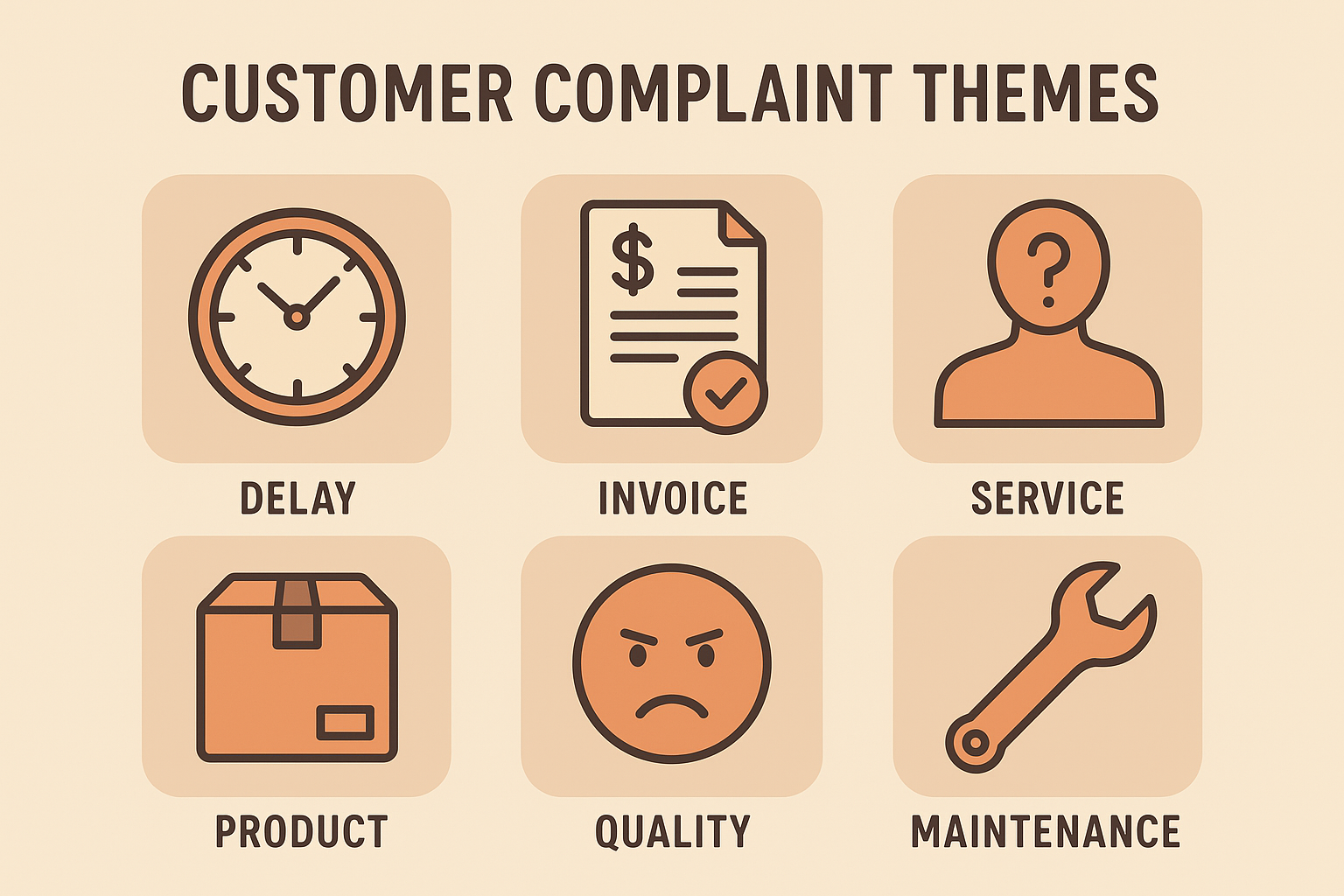
Named weakness themes turn scattered complaints into a usable marketing map.
Backfire Protection: The Step Most Competitive Analysis Tools Skip
Finding a competitor's weakness is only half the job. Before any campaign goes live, it is essential to ask a harder question: does your own business have the same problem? If your reviews also mention late arrivals, then a "we show up when we say we will" headline invites a direct comparison you are likely to lose.
This step, often called backfire protection, is the fastest way to stop wasting ad budget on claims your own customers would contradict publicly. In practice, it means running your own review history through the exact same analysis applied to competitors, flagging any overlap, and removing that angle from consideration entirely. Consequently, every message that survives this check is one you can defend with confidence.
The Federal Trade Commission's guidance on online customer reviews underscores why this matters: marketing claims need to hold up against publicly available evidence, and reviews are exactly that. Skipping this check does not just risk an awkward campaign; it risks a claim a prospective customer can disprove with one search.
Choosing the Right Competitive Intelligence Service for Your Market
Not every local business has the time to manually read thousands of reviews every month. For those that want this done consistently, a dedicated service is often the practical answer. WeakSpot, for example, monitors up to five competitors a business chooses, reads their entire Google review history, and clusters the negative reviews into named, scored weakness themes backed by verbatim quotes.
What sets this kind of service apart, however, is what happens after the analysis. Rather than ending with a dashboard, WeakSpot delivers finished campaign copy: Google Ads headlines validated against the 30 and 90 character limits, Meta ad copy within 40, 125, and 25 characters, Google Business Profile posts, SEO content briefs, and email hooks. None of the copy names a competitor directly, which keeps the messaging professional while still addressing a real, evidenced frustration.
Every engagement starts with a free self-analysis. A business owner submits a business name, website or Google Maps link, and email address, and results arrive within two business days with no call required. From there, two paid plans are available: Weak Spot Intel at $149 per month for two competitors with a monthly report and watch list alerts, and Market Edge at $299 per month, the most popular option, which covers five competitors, a full campaign pack, and a monthly self-analysis with backfire check. Both paid plans, aside from Weak Spot Intel, include a guarantee: if the first report does not surface at least three exploitable weaknesses, that month is free. A live product demo is available at app.weakspot.io/demo for businesses that want to see the process before committing.

Finished campaign copy, not just a report, is what turns analysis into results.
Frequently Asked Questions About Competitive Intelligence for Local Businesses
What is competitive intelligence for local businesses?
Competitive intelligence for local businesses is the practice of systematically studying competitors' public data, especially customer reviews, to find patterns in pricing, service quality, and customer experience that you can act on. For home-service companies, this usually means reading the 1 to 3 star reviews of nearby plumbers, roofers, or HVAC providers to see exactly what frustrates their customers.
How does competitive intelligence differ from regular market research?
Market research tends to look at broad industry trends, pricing surveys, and demographics. Competitive intelligence is narrower and more tactical, focusing on specific competitors' actual customer feedback so you can respond to their weaknesses directly in your marketing.
Why do local service businesses need competitor review analysis?
Because star ratings alone do not differentiate anyone. Most serious home-service competitors sit between 4.8 and 5.0 stars, so the only way to stand out is to read what the unhappy minority actually wrote and address those specific frustrations in your own messaging.
How many competitor reviews should you analyze before trusting a pattern?
A single complaint could be an outlier, but a theme that repeats across ten or more reviews, especially with similar wording, is a reliable pattern. Analyzing a competitor's entire review history, not just the most recent page, gives you a far more accurate picture than a quick skim.
What is backfire protection and why does it matter?
Backfire protection means checking your own reviews for the same complaint before you run a campaign built on a competitor's weakness. If you also get flagged for late arrivals, a "we show up on time" ad invites a comparison you would lose, so that angle gets dropped before it ever runs.
How much does a competitive intelligence service like WeakSpot cost?
WeakSpot's Weak Spot Intel plan starts at $149 per month for monitoring two competitors with a monthly report and watch list alerts. The Market Edge plan, the most popular option at $299 per month, covers five competitors, a full campaign pack, and a monthly backfire check.
How long does it take to get a free self-analysis?
After submitting a business name, website or Google Maps link, and business email at weakspot.io, results arrive by email within two business days. No sales call is required to see the initial findings.
Can competitive intelligence campaigns name competitors directly?
No, responsible competitive intelligence campaigns never name a specific competitor. Instead, the copy addresses the frustration pattern itself, such as surprise charges or missed arrival windows, which keeps the messaging professional and avoids legal risk.
What are the most common complaint themes in home-service reviews?
Recurring themes include surprise charges that differ from the original quote, missed arrival windows, rushed or incomplete jobs, callbacks that never happen, messy installation work, pushy upsells, and warranty claims that go nowhere. Each theme can be scored for how exploitable it is based on frequency and specificity.
How often should competitor intelligence reports be refreshed?
Monthly refreshes work best for most local markets, since new reviews accumulate steadily and rating trends can shift within weeks. A monthly cadence also lets you catch complaint surges or sudden rating drops while they are still useful to act on.
What's the difference between Weak Spot Intel and Market Edge plans?
Weak Spot Intel at $149 per month covers two competitors with a report and alerts but no campaign copy or self-analysis. Market Edge at $299 per month covers five competitors and adds a full campaign pack plus a monthly self-analysis and backfire check.
Do I need an ad agency to use the campaign copy?
No agency is required. The copy is formatted to drop directly into your own Google Ads, Meta Ads, and Google Business Profile accounts, though an agency can certainly manage the rollout if you already work with one.
What mistakes do businesses make when using competitor reviews in marketing?
The most common mistake is building a campaign around a weakness without first checking whether your own reviews mention the same problem. Another frequent error is relying on a handful of reviews instead of the full history, which can produce a misleading pattern.
Is analyzing public Google reviews legal and ethical?
Yes, Google reviews are public information that anyone can read, so analyzing them for business insight is both legal and widely practiced. The ethical line is in how the findings get used; responsible campaigns address patterns of frustration without naming or disparaging a specific competitor.
How do I get started with competitive intelligence for my business?
Start with a free self-analysis of your own reviews at weakspot.io, which arrives by email within two business days with no call required. From there, you can choose a monthly plan to begin monitoring up to five competitors you select.
Final Takeaway
Ultimately, competitive intelligence for local businesses is not about guessing at what makes a competitor weaker. It is about reading the reviews that are already public, finding the patterns that repeat, and checking your own history before claiming an advantage you cannot back up. In a market where every serious competitor averages close to five stars, this kind of evidence-based approach is often the only real differentiator left.
Above all, the businesses that win are the ones willing to do the reading, or willing to hand it to a service built for exactly that purpose. Whether you build the process yourself using the five steps above, or start with a free self-analysis at weakspot.io, the underlying principle stays the same: competitive intelligence for local businesses turns scattered complaints into a clear, defensible marketing advantage.
