Competitor review analysis is the practice of reading every review your rivals have received, not just the highlights, to find the complaint patterns hiding beneath a shiny star rating. For local home-service businesses like plumbers, roofers, and HVAC companies, this process uncovers exactly what frustrates customers at a 4.9-star competitor down the street. Instead of guessing why someone might switch, you get their own words explaining why they left.
This matters because a star average blends thousands of experiences into one number. However, a handful of one- and two-star reviews can reveal a specific, fixable weakness: late arrivals, surprise charges, or rushed installs. Below, we explain how this analysis works, why it changes local marketing, and how to use it without wasting ad budget on a claim your own reviews would contradict.
What Is Competitor Review Analysis?
Competitor review analysis is the systematic reading and categorizing of a rival business's public reviews to identify recurring complaints, exploitable weaknesses, and service gaps. Rather than skimming the top reviews on a profile page, the process works through the entire review history, including the one- and two-star entries most people never scroll down to read. The goal is to translate scattered complaints into named themes a business can act on.
For example, a roofing company might appear nearly flawless, sitting at 4.8 stars across 900 reviews. Underneath, though, thirty or more reviews might repeat the same frustration, such as crews missing scheduled arrival windows. Specifically, isolating that pattern turns a vague feeling into concrete marketing language. As a result, a competitor's weakness becomes a message the next advertiser can test, without naming names. You can see a working example of this kind of breakdown at weakspot.io.

Competitor review analysis means reading the full history of reviews, not just the ones shown first.
Why Review Analysis Matters for Local Service Businesses
In almost every local market, serious competitors cluster between 4.8 and 5.0 stars. Plumbers, HVAC companies, and roofers all look nearly identical on the surface. Consequently, many owners end up competing only on price or ad spend, bidding against rivals who appear just as trustworthy as they do.
However, a star rating is only an average. A competitor with 1,500 reviews and a 4.9 average can still carry thirty to fifty negative reviews describing specific, repeatable problems. For instance, "quoted one price, billed another" or "waited all day, nobody called" are not vague complaints. They are precise descriptions of what the next customer in that market is actively trying to avoid.
According to BrightLocal's local consumer review survey, the large majority of consumers regularly read online reviews before choosing a local business, and many specifically look for mentions of price, punctuality, or follow-through. In other words, the complaints hiding in a competitor's history are not internal feedback. They are a public map of unmet expectations in your market, and few businesses take the time to read it closely.
How to Analyze Competitor Reviews: A Step-by-Step Process
A reliable competitor review analysis follows a repeatable sequence. Therefore, the process below works whether you do it manually in a spreadsheet or through an automated service.
- Choose competitors to monitor. Select three to five direct rivals serving the same area and the same core services, since unrelated comparisons produce weak patterns.
- Pull the full review history. Gather every available review, not only the newest ones, because older complaints often reveal long-running operational issues.
- Isolate the one to three star reviews. This smaller group contains the detailed, specific frustrations that five-star reviews rarely mention.
- Cluster complaints into named themes. Group similar frustrations under clear labels such as surprise charges or missed arrival windows.
- Score each theme for exploitability. Rate every theme from one to ten based on frequency and influence on buying decisions.
- Check your own reviews for the same issue. Confirm the weakness is not one you share before building a campaign around it.
What Competitor Review Analysis Reveals That Star Ratings Hide
A single number cannot describe an experience. By contrast, a cluster of verbatim quotes can. In home-service markets specifically, the same weakness themes appear again and again once you read the low-star reviews closely.
- Surprise charges that do not match the original quote
- Missed arrival windows with no call or apology
- Rushed jobs that create callback requests
- Messy installs left for the homeowner to clean up
- Pushy upsells during a routine service visit
- Warranty runarounds when something fails early
Each theme, once scored for exploitability, becomes a candidate for a campaign headline. For example, a theme scoring nine out of ten because it appears in forty separate reviews is a far stronger target than one mentioned only twice. This scoring step is what separates a usable competitive analysis from a pile of unread complaints, a distinction explained further in sentiment analysis research on Wikipedia.
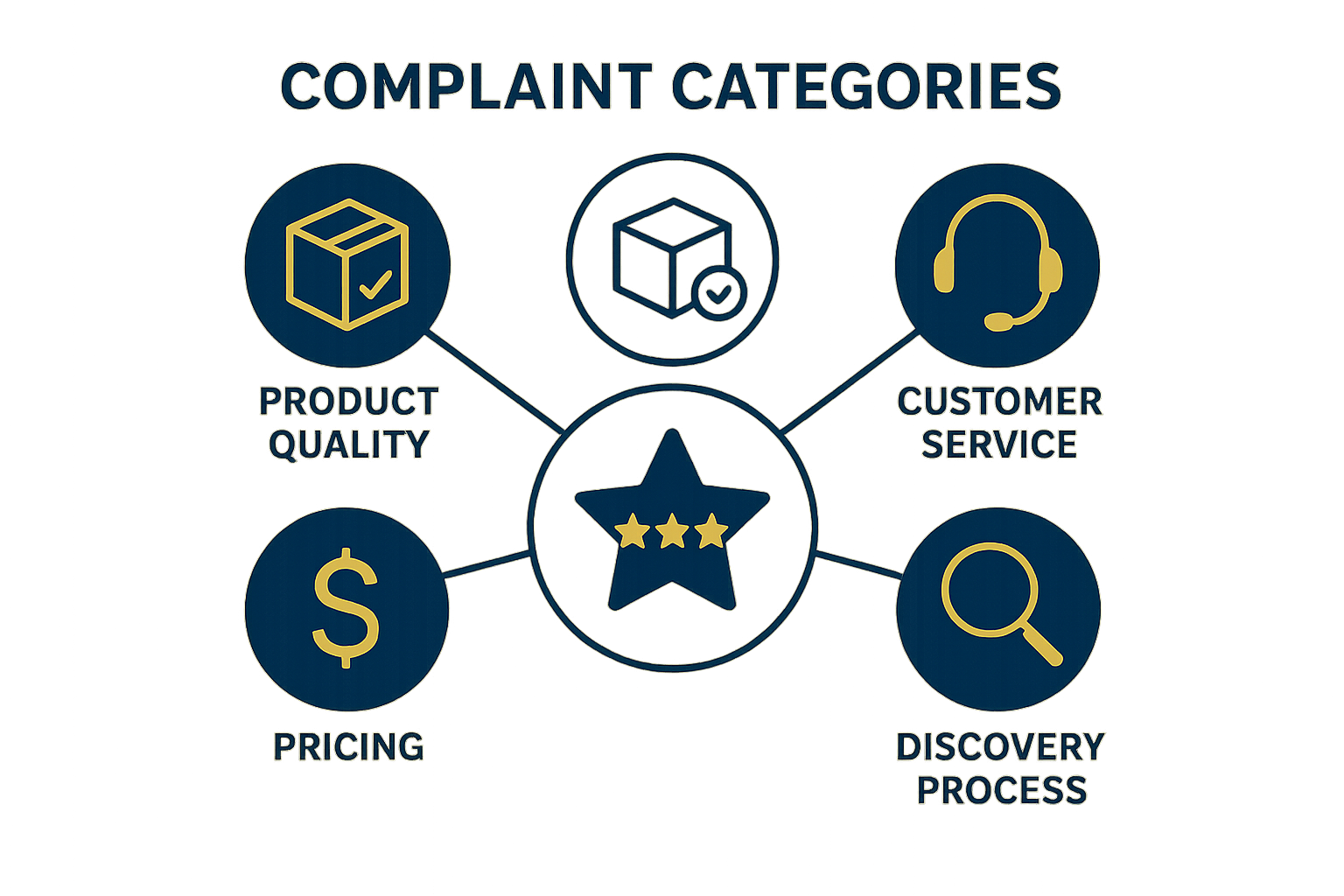
Grouping complaints into named themes is the core output of competitor review analysis.
Backfire Protection: The Step Most Review Analysis Skips
Before any weakness becomes a headline, it needs one more check. Specifically, you must confirm your own reviews do not show the same problem. If your customers also complain about late arrivals, then a "we show up when we say we will" campaign invites a comparison you would likely lose.
This step is often called backfire protection, and it is the fastest way to stop wasting ad budget on claims your own history contradicts. Consequently, every message that passes this check is one you can defend if a prospective customer checks your reviews after seeing the ad. The Federal Trade Commission's guidance on endorsements and online reviews reinforces why marketing claims need to hold up against publicly verifiable evidence, including your own review record.
Turning Review Analysis Into Campaign Copy
A finished report is only useful once it becomes copy you can run. Therefore, the final step converts each exploitable theme into platform-ready assets: Google Ads headlines validated against the 30 and 90 character limits, Meta ad copy within 40, 125, and 25 characters, Google Business Profile posts, SEO content briefs, and email hooks.
Notably, none of this copy should name a competitor directly, since doing so creates legal and platform-policy risk while rarely improving performance. Instead, the copy addresses the pain point itself, in the customer's own language. Services such as weakspot.io build this handoff directly into a monthly report, so an owner or their agency can drop the copy into existing ad accounts without additional writing.
Common Mistakes in Competitor Review Analysis
Even a well-intentioned analysis can go wrong. In particular, these mistakes show up repeatedly among local service businesses attempting this process for the first time.
- Reading only the newest or most visible reviews instead of the full history
- Skipping the check on your own reviews before launching a campaign
- Treating one or two mentions as a pattern instead of requiring repetition
- Naming a competitor directly, which invites policy and legal risk
- Writing copy that ignores each ad platform's character limits
Avoiding these errors is straightforward once the review set is organized by theme rather than read in chronological order. As a result, the analysis stays accurate, repeatable, and genuinely useful month after month. You can start with a free self-analysis of your own reviews before building any competitive campaign.

Turning a competitor review analysis into finished campaign copy is the step that actually moves leads.
Frequently Asked Questions About Competitor Review Analysis
What is competitor review analysis and how does it work?
Competitor review analysis is the process of reading a rival business's entire review history, not just the top comments, to find recurring complaint patterns. It works by isolating one- to three-star reviews, grouping similar complaints into named themes, and using verbatim quotes as evidence.
Why do businesses with 4.9-star ratings still have exploitable weaknesses?
A star rating is an average, so it hides outliers. A business with 1,500 reviews and a 4.9 average can still have thirty to fifty negative reviews describing the same specific frustration, such as missed arrival windows.
How many competitors should I include in a review analysis?
Most local service businesses get clear patterns by monitoring three to five direct competitors in the same category and service area. Fewer than three often produces too little data, while more than five becomes hard to act on each month.
What is backfire protection in review-based marketing?
Backfire protection means checking your own reviews for the same weakness before you run a campaign that targets a competitor's flaw. If your customers complain about the same issue, that angle gets flagged so you do not invite a comparison you would lose.
How long does a thorough competitor review analysis take?
Reading and categorizing a competitor's full review history manually can take several hours per competitor, especially for businesses with hundreds of reviews. Automated services typically deliver a finished report within one to two business days.
Does competitor review analysis cost money?
It can be done manually for free using time and attention, or through a paid service. Monthly intelligence plans for local service businesses commonly range from roughly $149 to $299 per month depending on the number of competitors and deliverables included.
Can I name a competitor directly in my ads based on their reviews?
Naming a competitor directly is legally risky and often against ad platform policies, and it rarely performs better than addressing the pain point itself. Most effective campaigns describe the frustration customers feel without identifying who caused it.
What is the difference between review analysis and simply reading reviews?
Reading reviews casually catches isolated impressions, while structured review analysis clusters complaints into repeatable themes and scores how exploitable each one is. The structured approach turns scattered opinions into a usable marketing asset.
What common mistakes hurt competitor review analysis?
The most common mistake is only reading the newest or most visible reviews instead of the full history. Another frequent error is skipping the check on your own reviews, which can lead to a campaign that highlights a weakness you share.
Which complaint themes show up most often for home-service businesses?
Common themes include surprise charges, missed arrival windows, rushed jobs, callbacks that never happen, messy installs, pushy upsells, and warranty runarounds. These patterns repeat across plumbing, HVAC, and roofing reviews in most local markets.
How do I turn review analysis findings into actual ad copy?
Start with the specific frustration in a customer's own words, then write a headline that promises the opposite experience without naming a competitor. Validate the copy against each platform's character limits before publishing.
Is competitor review analysis only useful for advertising?
No, the same findings can inform Google Business Profile posts, SEO content briefs, email campaigns, and even internal training on what not to repeat. Advertising is simply the fastest place to apply the insight.
Final Takeaway
Competitor review analysis turns an overlooked pile of one-star complaints into one of the most reliable sources of marketing insight a local business can access. Instead of guessing at a generic message, you work from the exact words a frustrated customer used to describe why they left a 4.9-star competitor. That specificity is what separates a forgettable ad from one that converts.
However, the analysis only works when it includes a check on your own reviews first, since a shared weakness makes any campaign backfire. Once that check is clear, the remaining step is simply formatting the finding into copy that fits each platform's limits. For home-service owners ready to see what their own reviews reveal, a free self-analysis at weakspot.io is a practical place to start, and the broader concept of reading competitor reviews systematically applies whether you build the report yourself or have it delivered monthly.
