
How to Steal Customers From Competitors: Proven Tactics
How to steal customers from competitors starts with a simple truth: in local home-service markets, almost every provider has a near-identical star rating, and that sameness is exactly what you can exploit. Plumbers, roofers, HVAC companies, and other residential service providers in the same city often sit between 4.8 and 5.0 stars on Google. Because nothing visibly separates them, owners end up competing on price and ad spend instead of on what customers actually care about. However, a star rating is only an average, and averages hide real, specific frustration.
Finding how to steal customers from competitors often starts with the handful of reviews everyone else skips past.
What Does It Mean to Steal Customers From Competitors?
How to steal customers from competitors is the process of identifying specific, documented weaknesses in a rival business, such as pricing surprises, missed callbacks, or rushed jobs, and building marketing messages that speak directly to customers who have lived through that exact frustration. It is not about dishonesty or copying a rival's name. Instead, it means reading what their own customers already wrote in public and answering the objection before the next customer even asks it.
In practice, this means treating public review data as research. A competitor with a 4.9-star average and 1,500 reviews can still carry thirty to fifty genuinely unhappy customers who wrote down exactly why they left. Those written complaints are specific, searchable, and free to study.
Why Nearly Every Local Competitor Looks the Same on Google
Research from Pew Research Center found that 82% of U.S. adults at least sometimes read online reviews before buying something for the first time. As a result, every serious home-service provider has learned to chase a near-perfect rating, and most of them succeed on the surface. That creates a problem for the business owner trying to grow: if every competitor looks the same at a glance, customers fall back on price or whoever shows up first in search.
In contrast, the written reviews underneath that star average tell a different story. A technician who showed up three hours late, a quote that doubled at the door, a warranty claim that went nowhere, these details are specific in a way a star rating never is. For example, "the crew tracked mud through the house and never came back to finish" communicates far more than any four-star icon. Therefore, the opportunity is not in the rating itself but in the text beneath it.
How to Steal Customers From Competitors Using Public Review Data
The direct answer: review your top five competitors' full Google review history, cluster their one- to three-star complaints into named weakness themes, verify that you do not share the same weakness, then build campaign copy around the themes you can actually win on. This turns a vague sense of "we're better" into a specific, quotable advantage.
According to the Federal Trade Commission's guidance on online reviews and marketing, businesses must avoid misleading claims, which is one reason this process should rely on patterns across many reviews rather than cherry-picking a single angry post. A single bad review could be an outlier. A theme that repeats across twenty or thirty reviews is a pattern worth building a message around.
A Step-by-Step Process to Win Customers Away From Rivals
Here is the sequence that turns scattered complaints into a usable campaign:
- Identify the five local businesses that actually compete with you in search results, not just the ones you personally think of as rivals.
- Read through every one- to three-star review each competitor has received, since the real patterns usually hide past the first page.
- Group similar complaints into named themes, such as surprise charges, missed arrival windows, or messy installs, so the pattern becomes obvious.
- Score each theme from one to ten for how exploitable it is, backed by verbatim quotes pulled directly from the reviews.
- Run your own reviews through the same process before you commit to a theme, so you never promote a promise your own customers contradict.
- Write campaign copy for each surviving theme across Google Ads, Meta ads, Google Business Profile posts, SEO content, and email.
- Launch the copy in your own ad accounts and keep watching for new complaint surges or rating drops at the competitors you track.
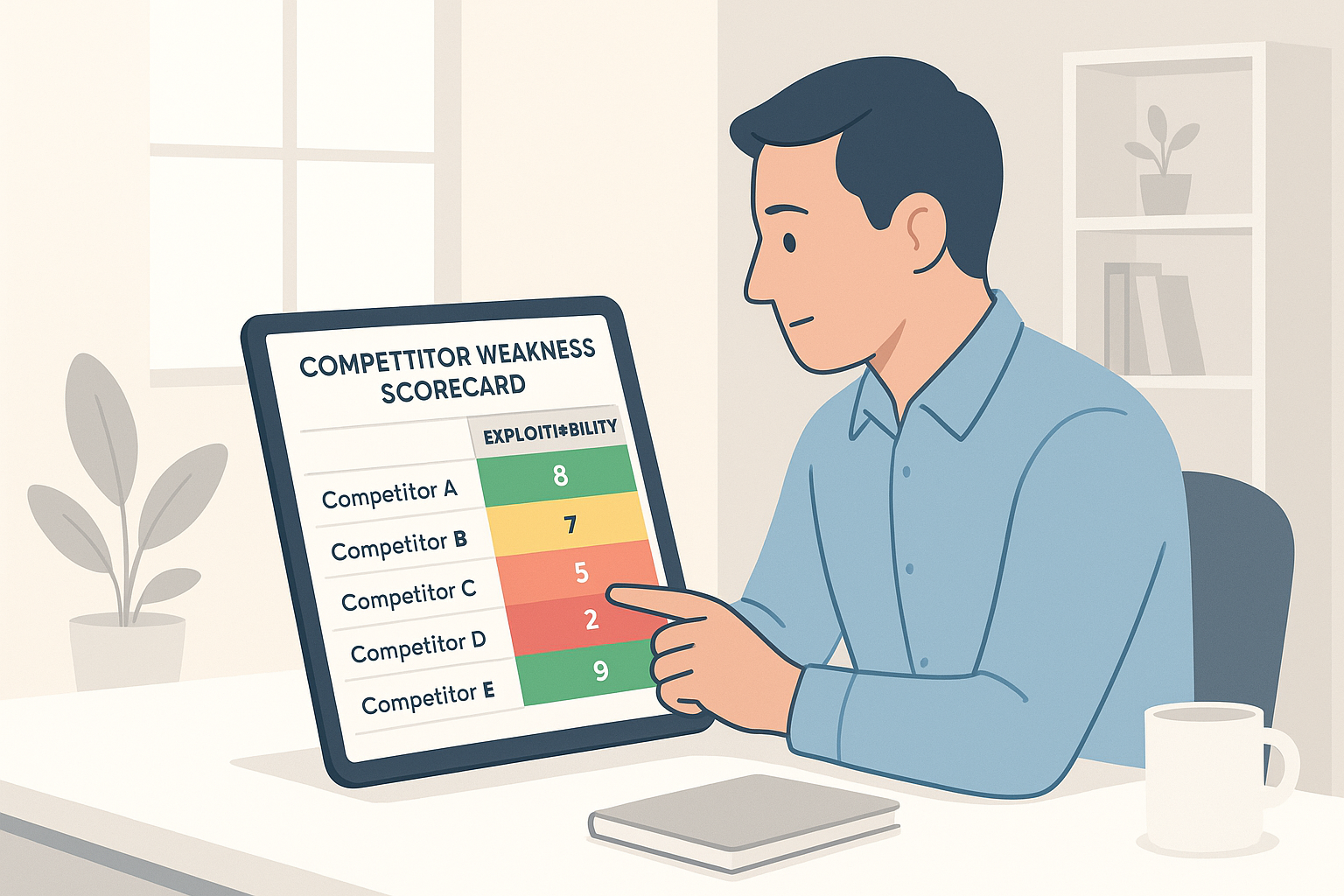 Scoring each weakness theme for exploitability turns a pile of reviews into a usable marketing plan.
Backfire Protection Keeps You From Losing the Customers You're Trying to Win
Before any weakness theme becomes an ad, it should be checked against your own reviews. If your customers also complain about late arrivals, a "we show up when we say we will" campaign invites a comparison you would lose. This step, sometimes called backfire protection, is the part most businesses skip when they try this manually.
In fact, this is the stage where a dedicated service like WeakSpot adds the most value. Rather than stopping at a dashboard that simply flags a problem, the analysis runs your own review history through the identical process used on competitors, so every theme that survives is one you can genuinely defend. That distinction matters more than it sounds, because a confident claim that gets contradicted in the comments section can do more damage than no claim at all.
Turning Weakness Themes Into Ready-to-Run Campaign Copy
Once a theme is scored and cleared, the next step is writing copy that fits each platform's actual constraints. Google Ads headlines need to respect the standard 30-character headline and 90-character description limits, while Meta ad copy needs to stay within the platform's 40, 125, and 25-character fields for primary text, headline, and description. According to Google's own guidance on managing reviews, businesses are encouraged to respond to and learn from customer feedback, which reinforces how central review data already is to how these platforms expect businesses to operate.
A finished campaign pack typically includes several formats built from the same weakness theme: a Google Ads variation, a Meta ad, a Google Business Profile post, a short SEO content brief, and an email subject line. None of them name a competitor directly. Instead, each one describes the problem a customer might be trying to avoid, which keeps the messaging both effective and professional.
Common Mistakes That Stop Businesses From Attracting Customers Away From Competitors
Several mistakes show up repeatedly when business owners try this on their own. First, many build a campaign around a single angry review instead of a repeated pattern, which weakens the message's credibility. Second, plenty of businesses skip the backfire check entirely and end up promoting a promise their own reviews undercut.
Third, some owners name competitors directly in ads, which can draw complaints from the platform and looks unprofessional to customers. Finally, many businesses analyze competitors once and never again, missing new complaint surges or a competitor quietly fixing the exact weakness the campaign was built around. For additional background on how word-of-mouth shapes buying decisions, see Wikipedia's overview of word-of-mouth marketing.
 The goal is never to insult a rival, only to speak to the frustration their own customers already described.
How a Free Self-Analysis Fits Into This Process
Most businesses that explore this approach start with a free self-analysis rather than jumping straight to competitor research. The idea is straightforward: before pointing a spotlight at anyone else, check whether your own Google reviews contain the same weaknesses you would want to exploit elsewhere. A platform like WeakSpot's competitive intelligence service runs this analysis by email within two business days, with no sales call required, so an owner can see their own exploitable and non-exploitable themes before committing to anything further.
From there, a business can choose to track up to five competitors, receive a monthly intelligence report, and get a full campaign pack of ready-to-run copy. A live product demo is also available for anyone who wants to see the reports and campaign copy before signing up for a monthly plan.
Frequently Asked Questions About How to Steal Customers From Competitors
What does it mean to steal customers from competitors?
How to steal customers from competitors means finding documented weaknesses in a rival's service, such as missed arrival windows or surprise charges, and building marketing that speaks directly to customers who have had that exact frustration. It relies on public review data, not tricks or false claims.
Is it legal to use a competitor's reviews in your marketing?
Yes, because Google reviews are public information and you are analyzing patterns, not fabricating claims. Campaigns should describe the problem a customer might face, such as surprise fees, without naming the competitor directly.
What is backfire protection and why does it matter?
Backfire protection means checking your own reviews for the same complaint before you run a campaign that highlights it in a competitor. Without it, a business might promote "on-time arrivals" while its own reviews mention late techs, inviting a comparison it cannot win.
How is this different from just reading reviews myself?
Reading a handful of reviews manually misses patterns buried across hundreds of entries, especially the one- to three-star reviews people rarely scroll to. A structured analysis clusters complaints into named themes and scores each one for how exploitable it is.
Can I name competitors directly in my ads?
It's best practice to avoid naming competitors directly in ad copy. Describing the problem, such as "no surprise charges at the door," is more effective and lower risk than calling out a specific business by name.
What makes a weakness theme "exploitable" rather than just a bad review?
An exploitable theme shows up repeatedly across many reviews, is specific enough to quote directly, and is not shared by your own business. A single angry review about one bad day is not the same as a pattern of twenty reviews describing the same billing surprise.
Conclusion: Turning Public Reviews Into Your Next Campaign
Ultimately, how to steal customers from competitors comes down to paying attention to what everyone else already ignores: the specific, written complaints sitting beneath a near-perfect star rating. Competitors cannot hide a pattern of late arrivals or surprise charges once thirty or fifty customers have described it in their own words. However, the same discipline has to apply to your own reviews first, or the campaign will backfire the moment a prospective customer checks your history too.
Businesses that treat this as an ongoing process, rather than a one-time project, tend to see the most consistent results. Checking competitors monthly, verifying your own weaknesses, and refreshing campaign copy as new complaints surface keeps the advantage current instead of stale. Visit weakspot.io to start with a free self-analysis and see exactly which weaknesses are safe to build a campaign around.
