Home services competitive analysis is how a plumber, roofer, or HVAC owner figures out what their rivals are actually bad at, instead of guessing from a star rating that looks nearly identical across the whole market. In most local categories, every serious competitor sits between 4.8 and 5.0 stars, so on the surface there is nothing to separate one company from another. However, averages hide a lot, and the one to three star reviews beneath that shiny number are where the real differentiation lives.
Consider a competitor with 1,500 reviews and a 4.9 average. Statistically, that still leaves thirty to fifty unhappy customers who wrote down, in detail, exactly what went wrong. "Quoted one price, billed another." "Waited all day, nobody called." Those complaints are public, specific, and repeatable, which is precisely why they matter for marketing. In particular, they describe the exact frustration the next customer in that market is trying to avoid.
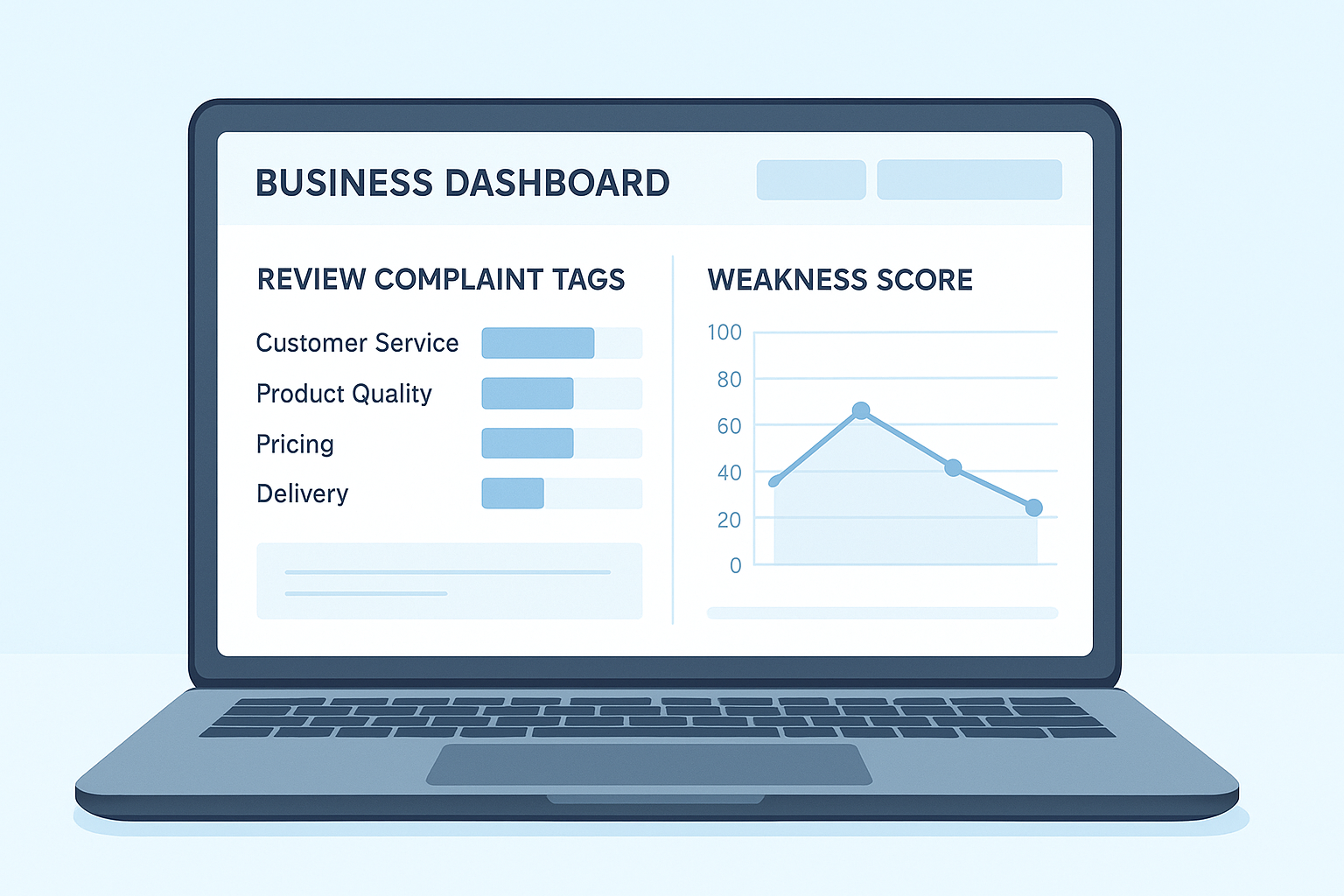
Home services competitive analysis clusters a competitor's negative reviews into named, scored weakness themes.
What Is Home Services Competitive Analysis?
Home services competitive analysis is the process of studying local competitors, usually plumbers, roofers, electricians, HVAC companies, or similar providers, to identify where they are strong, where they are weak, and how a customer could be won away. Rather than comparing price lists or service menus alone, the most useful version of this analysis mines public Google reviews for recurring complaint patterns.
As a result, the output is not a vague impression like "their service could be better." It is a specific, repeated grievance in a customer's own words, such as a fee nobody mentioned on the phone or a callback that never came. That specificity is what makes the analysis usable for marketing rather than just interesting to read.
Why a 4.9-Star Average Doesn't Mean You Have No Competitive Edge
Owners often assume that if every competitor looks nearly perfect online, there is nothing left to compete on except price and ad spend. In reality, the opposite is true. According to BrightLocal's Local Consumer Review Survey, the large majority of consumers read online reviews before choosing a local business, and many read several reviews before deciding. That means the negative reviews, even a small number of them, get real attention from the exact people deciding between you and a competitor.
Furthermore, a customer review is a self-selected, voluntary account, which means people who write one-star reviews are often more detailed and specific than people who leave a quick five-star rating. Consequently, the complaint corpus tends to be rich with exact language: times, amounts, and promises broken. That language is gold for positioning copy, because it mirrors how real customers describe their fears before they ever call a contractor.
In contrast, generic ad copy about being "licensed and insured" or "family owned since 1998" rarely moves anyone, because nearly every competitor claims the same thing. A message built on a verified, specific competitor weakness is different. It speaks directly to a frustration the reader may have already experienced somewhere else.
How to Run a Home Services Competitive Analysis in 6 Steps
Running a thorough home services competitive analysis does not require expensive software, though it does require discipline, since skipping steps is where most owners go wrong. Below is the process broken into manageable stages.
- Identify your real competitors. List up to five businesses that genuinely compete for the same customers, matching your service area and price tier, not every company in your category.
- Pull the full review history. Read every review for each competitor, not just the first page, because older complaints often reveal patterns that have quietly persisted for years.
- Isolate and cluster the negative reviews. Separate the one to three star reviews and group them into named themes, such as surprise charges, missed arrival windows, or rushed installs.
- Score each weakness for exploitability. Rate every theme from one to ten based on how often it repeats and how directly a message could address it.
- Run the same analysis on yourself. Check your own reviews for the identical weakness before building a campaign, so you never attack a problem your own customers also mention.
- Convert the findings into campaign copy. Turn only the verified, backfire-checked themes into ad headlines, Google Business Profile posts, and email hooks.
Services like WeakSpot automate most of this process for home service businesses such as plumbers, roofers, and HVAC companies, reading every competitor review rather than a sample, then handing back finished copy instead of a dashboard.
Scoring each weakness theme turns raw complaints into a prioritized list for marketing.
Turning Competitor Review Analysis Into Campaign Copy
Finding a weakness is only half the job. Afterward, the real value comes from translating "quoted one price, billed another" into a Google Ads headline, a Meta ad, and a Google Business Profile post, each one respecting the character limits of its platform. Google Ads headlines, for instance, are capped at 30 characters per headline and 90 characters per description, so the message has to be tight and specific.
Similarly, Meta ad copy is constrained to roughly 40, 125, and 25 characters across the primary text, headline, and description fields. Because of these limits, the strongest campaigns lean on short, concrete claims drawn directly from the verbatim complaint, such as promising a firm arrival window or an itemized quote before work begins. For a deeper look at building this kind of message, see this guide on home service marketing content that actually converts frustrated customers.
Importantly, strong campaign copy never names the competitor directly. Instead, it describes the frustration in general terms a reader will recognize from their own experience, which keeps the message ethical while still being unmistakably specific.
Backfire Protection: Why You Must Analyze Your Own Reviews Too
Before any weakness becomes a headline, it needs one more check. If your own reviews mention the same problem you are about to attack, that campaign will backfire the moment a prospective customer checks your profile.
Specifically, a "we show up when we say we will" campaign only works if your own arrival record actually supports it. Otherwise, you are inviting a direct comparison you will lose. This step, sometimes called backfire protection, is the single fastest way to stop wasting ad budget on a claim your own customers already contradict in writing. For more detail on using reviews defensively as well as offensively, this piece on positioning your business against competitors using Google reviews walks through the logic further.
The FTC's endorsement and review guidance also reinforces why honesty in review-based marketing matters: claims drawn from public review data should accurately reflect real customer experience, including your own.
What a Monthly Home Service Competitive Intelligence Report Should Include
Because new reviews accumulate every week, a one-time snapshot goes stale quickly. A useful monthly report generally contains three parts: a scorecard ranking each competitor's weakness themes with verbatim evidence, a campaign pack of ready-to-run copy for the strongest themes, and a watch list that flags new complaint surges or sudden rating drops.
In this structure, the report tells you where you can win head-to-head and, just as usefully, where you should not pick the fight. WeakSpot delivers exactly this combination for up to five competitors at a time, starting with a free self-analysis of your own reviews submitted at weakspot.io and returned within two business days, no call required.
A finished campaign pack turns competitor complaints into headlines ready for Google Ads and Meta.
Frequently Asked Questions About Home Services Competitive Analysis
What is home services competitive analysis?
Home services competitive analysis is the process of studying competing plumbers, roofers, HVAC companies, or other local contractors to find where they are weak and where they are strong. The most reliable version of this analysis mines public Google reviews for complaint patterns rather than guessing from star ratings alone.
How do you perform a competitive analysis for home service businesses?
You identify up to five real local competitors, pull their full Google review history, and separate the one to three star reviews from the rest. Those negative reviews get clustered into named themes like surprise charges or missed arrival windows, then scored for how exploitable each theme is in your marketing.
Why does home services competitive analysis matter for a small contractor?
Small contractors usually cannot outspend larger competitors on ads, so differentiation has to come from message, not budget. Because nearly every provider in a local market sits between 4.8 and 5.0 stars, finding specific, verbatim complaints is often the only real advantage left to compete on.
What is the difference between home services competitive analysis and generic competitor research?
Generic competitor research usually looks at pricing pages, service areas, and ad spend estimates. Home services competitive analysis goes further by reading the full negative review corpus for each competitor and turning repeated customer complaints into ready-to-run campaign angles.
How much does a home services competitive analysis cost?
Costs vary by provider and depth. WeakSpot, for example, offers a free self-analysis of your own reviews, then paid monthly plans starting at $149 for a two-competitor intelligence report, up to $299 for five competitors with full campaign copy and monthly backfire checks.
How long does it take to get results from a competitive analysis?
A self-analysis of your own reviews typically returns within two business days with no call required. A full competitor intelligence report, including weakness scoring and campaign copy, is usually delivered on a monthly cycle so themes stay current.
What are the most common mistakes in home services competitive analysis?
The most common mistake is stopping at the star rating and assuming a 4.9 average means there is nothing to exploit. A second common mistake is building a campaign around a weakness your own reviews also show, which invites a comparison you cannot win.
What are best practices for competitive analysis in the home service industry?
Best practice is to read the entire negative review history for each competitor, not just the first page of one-star complaints. Equally important is checking your own reviews for the same weakness before you run a campaign against it, which is sometimes called backfire protection.
Can a competitor's high star rating hide real problems?
Yes. A 4.9-star average built on 1,500 reviews can still contain thirty to fifty detailed complaints about billing surprises, missed windows, or rushed jobs. Those reviews are public and specific, and most competitors never read them closely enough to fix the pattern.
What is backfire protection in competitive intelligence?
Backfire protection is the practice of running your own Google reviews through the same weakness analysis you apply to competitors before launching a campaign. If your customers complain about the same issue, that angle gets flagged so you never advertise a claim your own reviews contradict.
How many competitors should I monitor in a home services competitive analysis?
Most local markets only have three to five serious competitors worth tracking closely. Monitoring more than that usually dilutes focus without adding meaningfully different weakness themes.
Do I need an agency to act on competitive analysis insights?
No. Finished campaign copy built from a competitive analysis, such as validated Google Ads headlines or Meta ad text, can be dropped directly into your own ad accounts. An agency can help with execution, but the insight and copy do not require one.
What tools help with home services competitive analysis?
Review monitoring platforms, rank trackers, and manual spreadsheet audits can all contribute. Purpose-built services like WeakSpot go further by clustering a competitor's entire negative review history into scored, named weakness themes with verbatim evidence.
Is analyzing competitor reviews legal and ethical?
Yes. Google reviews are public data that anyone can read, and summarizing complaint patterns is no different from a human reading reviews manually. Ethical campaigns built on this research describe the frustration customers experience without naming the competitor directly.
How often should a home services competitive analysis be updated?
Monthly refreshes work well for most local markets because new reviews accumulate steadily and ratings can shift after a bad quarter. A monthly cadence also lets you catch new complaint surges or rating drops before a competitor fixes the problem.
Final Thoughts on Home Services Competitive Analysis
In the end, home services competitive analysis works because it replaces guesswork with evidence that already exists in plain sight. Every competitor's negative reviews describe, in specific and repeatable language, exactly what the next customer in your market is hoping to avoid. Therefore, the business that reads those reviews closely, checks its own record first, and turns the findings into clear, honest campaign copy is the one that wins the customer who almost signed with someone else.
Owners who want to see this in practice can start with a free self-analysis at weakspot.io, submitting a business name, website, and email to get results within two business days, or explore a live demo at app.weakspot.io/demo before committing to a monthly plan.
