
Positioning Against Competitors Using Google Reviews
Positioning against competitors is the practice of proving, in specific and verifiable terms, why a customer should choose your home-service business over the next name in the search results. For plumbers, roofers, HVAC contractors, and similar local providers, that practice has grown harder, not easier, because nearly every serious rival now sits between 4.8 and 5.0 stars on Google. When every option looks equally polished, positioning against competitors on price or ad spend alone simply drains your budget. Therefore, the smarter approach starts with the reviews nobody else bothers to read closely: the one-, two-, and three-star complaints buried beneath a competitor's glowing average.
What Is Positioning Against Competitors?
Positioning against competitors means identifying the specific gaps, frustrations, or unmet expectations that rival businesses leave behind, then building your marketing message around solving exactly that problem. Instead of claiming to be "the best," effective positioning names a concrete pain point, such as missed arrival windows or surprise billing, and shows evidence that your business handles it differently.
In broader marketing theory, this discipline traces back to classic positioning (marketing) strategy, which argues that a brand wins the space it owns in a buyer's mind, not the space it merely claims in an ad. In traditional marketing, positioning often relies on taglines or feature lists that a competitor can copy within days. In home services, however, public review data gives a far more durable foundation. According to Pew Research Center, 82% of U.S. adults at least sometimes read online reviews before buying something for the first time. As a result, a competitor's complaint pattern becomes effectively public record the next customer can stumble across, which turns it into a usable marketing asset rather than just a data point.
Positioning against competitors starts with reading the reviews everyone else skips.
Why Competitive Positioning Breaks Down When Everyone Has 4.9 Stars
A star rating is an average, and averages hide a lot. A competitor with 1,500 reviews and a 4.9 average can still carry thirty to fifty one- and two-star reviews, each written by a customer who was frustrated enough to document exactly what went wrong. Most shoppers only see the headline number. However, Google's own guidance on Business Profile reviews confirms that the aggregate score is a rolling average, not a snapshot of every interaction, so a near-perfect figure can still mask a persistent pattern underneath it.
Consequently, two businesses with identical 4.9 averages can have completely different weaknesses. One might struggle with late arrivals, while the other rushes installs to hit a daily quota. Without reading the actual text of the negative reviews, a business owner cannot tell these two competitors apart, let alone build a message that beats either one. This is exactly where generic competitive positioning stalls out, because it treats every 4.9-star competitor as equally strong when they are not.
The Positioning Statement Framework, Adapted for Local Service Businesses
Most competitive positioning guides borrow a template built for software companies: "For [target customer] who [need], [product] is a [category] that [key benefit]. Unlike [primary alternative], we [key differentiator]." It works, in theory, but it collapses the moment a home-service owner tries to fill in the "unlike" blank with a guess instead of evidence.
In particular, the fix is to swap the guess for a documented complaint. For example: "For homeowners who need a same-day plumbing repair, [Company] is a licensed local plumber that shows up inside the promised window. Unlike other highly rated plumbers nearby, whose customers report two-hour windows turning into next-day visits, we confirm arrival time by text 30 minutes out." Specificity like that cannot be copied overnight, because it is backed by a pattern the competitor actually created.
How to Build Positioning Against Competitors From Review Data
Building a defensible position does not require guesswork. Instead, it requires a repeatable process, similar to how a competitive intelligence team would approach a larger market, scaled down to what a local service business can realistically do each month.
- Identify up to five direct competitors. Pull their Google Business Profile links and confirm they serve the same service area and job types you do.
- Read every low-star review. Go through every one-, two-, and three-star review for each competitor, not just the first page Google shows, because older complaints often repeat the same unresolved issue.
- Cluster complaints into named themes. Group the complaints into themes such as surprise charges, missed arrival windows, rushed jobs, or warranty runarounds, and note how often each one appears.
- Score each theme for exploitability. Rate each theme from 1 to 10 based on frequency, specificity, and how recently it was mentioned, so you know which weakness to lead with first.
- Run your own reviews through the same process. Checking your own history first matters, because a campaign built on a weakness you also share will backfire the moment a prospect compares you.
 Behind every near-perfect average sits a set of named, documented weaknesses.
Backfire Protection: Checking Your Own Reviews First
Before any weakness becomes a headline, it needs a backfire check. If a plumbing company's own reviews also mention late arrivals, a "we show up when we say we will" campaign invites a side-by-side comparison the business would lose. This step is the one most owners skip, because running their own reviews through the same thematic analysis takes almost as much time as analyzing the competition in the first place.
Research from Northwestern University's Spiegel Research Center found that purchase likelihood peaks for ratings between 4.0 and 4.7 stars and drops as ratings approach a perfect 5.0. In other words, buyers read the complaints behind the stars, so an unchecked complaint, on either side of a comparison, carries real weight in a buyer's decision.
As a result, backfire protection has become a default step for tools built specifically for this job. WeakSpot, for example, screens every proposed campaign angle against a business's own review history before that angle ever reaches a finished ad, which keeps the final copy honest and harder to counter. For a closer look at how local businesses apply this kind of research, see competitive intelligence for local businesses.
What Market Positioning Looks Like in Practice
Specificity is what separates a usable market positioning angle from a vague one. "Their service could be better" does not move anyone. A verbatim complaint does.
"They said a two-hour window, then showed up the next afternoon." — Example of a verbatim review pattern
That single sentence, repeated in slightly different words across a dozen reviews, becomes a theme: missed arrival windows. Scored high on exploitability, it can turn directly into a Google Ads headline validated against the 30 and 90 character limits, a Meta ad within the platform's 40, 125, and 25 character fields, and a Google Business Profile post, all without ever naming the competitor by name. The weakspot.io self-analysis tool is one way to see this process applied to your own market before committing to a monthly plan, starting with a free report sent within two business days.
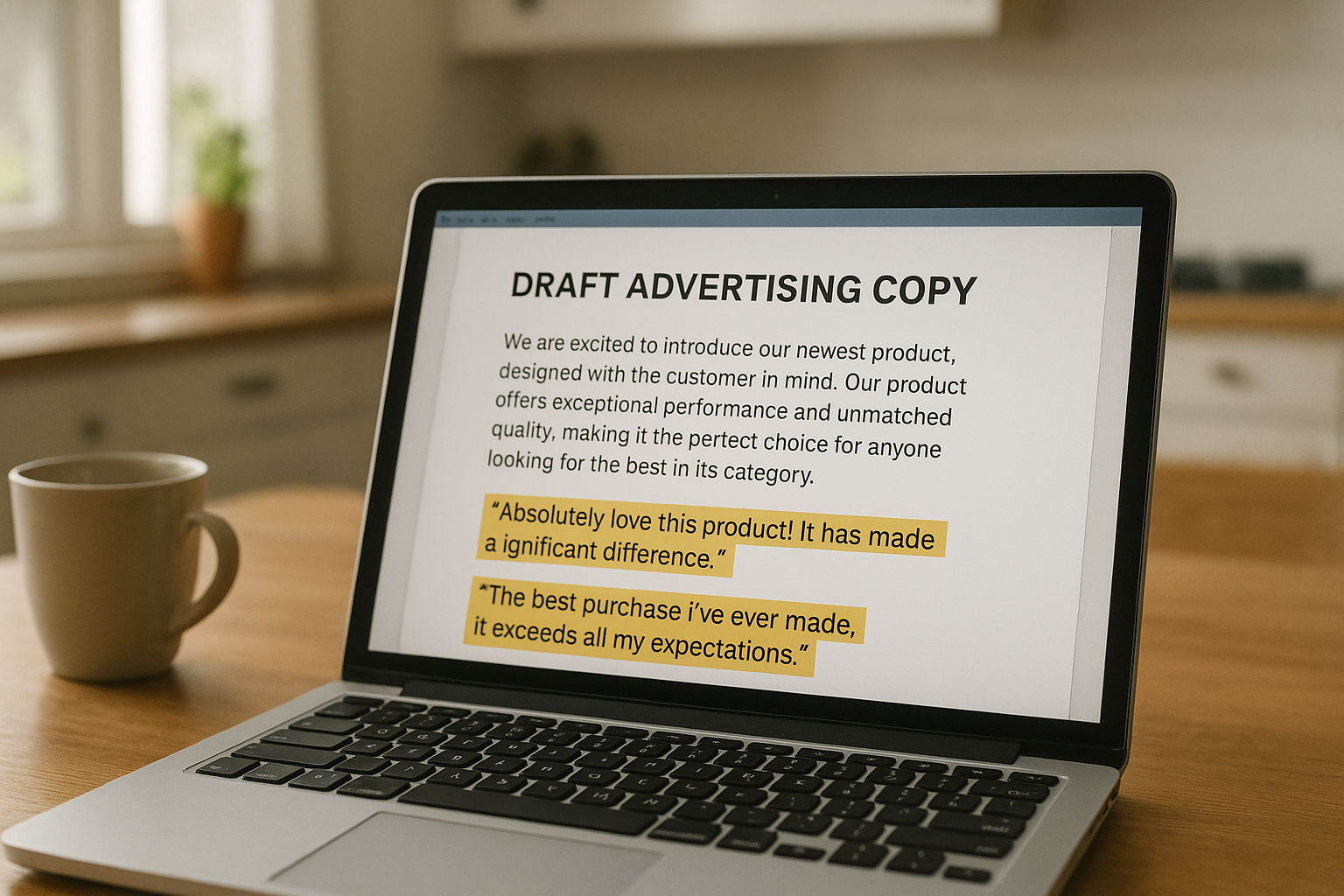 Finished campaign copy, built directly from verbatim competitor review quotes.
Positioning Against Competitors: Examples Across Home-Service Trades
The same five-step process produces different winning themes depending on the trade. In particular, plumbing, HVAC, and roofing companies each tend to collect distinct complaint patterns, which is why a one-size-fits-all positioning template rarely works.
- Plumbing: Surprise charges after the quote and rushed drain jobs top the list. A full walkthrough of this process for the trade lives in our plumbing competitor analysis guide.
- HVAC: Pushy upsells during a routine tune-up and callbacks that never get scheduled dominate the one- and two-star reviews.
- Roofing: Vague timelines and communication gaps between the estimate visit and the actual install crew show up again and again.
Above all, the trade matters less than the discipline of reading the reviews yourself. For a broader set of tactics beyond positioning alone, our guide on how to steal customers from competitors covers the full acquisition playbook this feeds into.
Common Mistakes That Sabotage a Competitive Positioning Strategy
Even with good data, a few recurring mistakes undo the value of the research. Avoiding them is often the difference between a campaign that converts and one that quietly gets reported or ignored.
- Naming the competitor directly. This invites legal risk and platform rejections on Google Ads and Meta alike.
- Skipping the backfire check. Leading with a weakness your own reviews share is the single fastest way to lose trust.
- Treating analysis as a one-time task. Review patterns shift monthly, so a single snapshot goes stale fast.
- Leading with vague claims. "Better service" convinces no one; a verbatim quote does.
Positioning Against Competitors vs. Traditional Battlecards
Larger B2B companies often rely on competitive intelligence platforms that build static "battlecards," which are reference sheets sales teams use to counter a rival's pitch in real time. Those tools work well for enterprise sales conversations, but they were not built for a local service business trying to win a Google search.
In contrast, review-based positioning updates automatically as new complaints appear, requires no sales team to operate, and feeds directly into ad copy rather than an internal slide deck. Consequently, a home-service owner gets a lighter, faster version of the same discipline enterprise teams use, scaled to a market of five competitors instead of fifty.
Metrics That Prove Your Positioning Strategy Is Working
Specifically, track these four signals over the 60 to 90 days after launching review-based campaigns:
- Click-through rate on ads that reference a specific weakness theme versus generic copy.
- Cost per lead compared to the prior quarter's generic positioning spend.
- Your own star rating trend, which should hold steady or rise if the backfire check was done correctly.
- New review mentions of the exact theme you positioned against, signaling the message is being noticed.
Frequently Asked Questions About Positioning Against Competitors
What does positioning against competitors mean for a home-service business?
Positioning against competitors means building your marketing message around a specific, provable weakness your rivals have, rather than a generic claim like "great service." For home-service businesses, that weakness usually comes straight from the negative reviews competitors already have on Google.
Why do star ratings fail to show real differences between competitors?
A star rating is an average, so a business with 1,500 reviews and a 4.9 score can still have thirty to fifty detailed complaints buried underneath it. Two competitors with identical averages can have completely different underlying weaknesses.
What is backfire protection and why does it matter?
Backfire protection means checking your own reviews for the same complaint before you run a campaign that calls out a competitor's weakness. Without it, you risk inviting a comparison your own customers would contradict.
What mistakes do businesses make when positioning against competitors?
The most common mistake is building a campaign around a weakness the business shares with its competitor, which backfires the moment a prospect compares reviews. Another common mistake is relying on vague claims instead of specific, quote-backed evidence.
Should campaign copy name a competitor directly?
No, best practice is to never name a competitor directly in ad copy. Instead, describe the problem itself, such as surprise charges or missed arrival windows, so the message stays accurate and avoids legal or platform issues.
What weakness themes show up most often in negative home-service reviews?
The most common themes include surprise charges after the quote, missed or delayed arrival windows, rushed installations, callbacks that never happen, and pushy upsells. Each theme becomes exploitable once it repeats across multiple verbatim reviews.
How is positioning against competitors different from traditional competitive intelligence?
Traditional competitive intelligence platforms build static battlecards for enterprise sales teams, updated manually on a schedule. Positioning against competitors through review data updates continuously and feeds straight into ad copy, with no sales team required to operate it.
How often should a business refresh its competitive positioning research?
Monthly is the practical minimum, since new reviews can shift the strongest weakness theme within a few weeks. A business that checks quarterly or less often risks leading with a complaint a competitor has already fixed.
Key Takeaways
Positioning against competitors no longer works well as a game of adjectives when every serious rival in a local market sits near 4.9 stars. Instead, it works as a disciplined reading exercise: pull the negative reviews, cluster the complaints into named themes, score each one for exploitability, and check your own reviews before you commit to a message. Above all, the businesses that win this cycle are the ones treating public review data as a standing research asset rather than a one-time glance before buying ads. For a home-service owner who wants to see this applied to their own market without a sales call, weakspot.io offers a free self-analysis as the starting point, and a live demo is available for owners who want to see the full report format first.
