HVAC competitor analysis is the practice of studying rival heating and cooling companies in your service area, including their pricing, marketing, and most importantly, what customers say about them in public reviews. In almost every local market, HVAC companies sit between 4.8 and 5.0 stars, so the rating itself tells you nothing. The real differences hide inside the reviews nobody bothers to read.
Quick answer: HVAC competitor analysis means reading your rivals' full Google review history, isolating the one-to-three star complaints, and grouping them into themes you can build marketing around. The owners who do this consistently win more quote requests than the ones competing only on price.

Reading the full review history, not just the star average, is the core of HVAC competitor analysis.
What Is HVAC Competitor Analysis?
HVAC competitor analysis is the structured process of gathering public information about rival companies to find where they are strong and, more usefully, where they are weak. Specifically, it means looking past the overall star rating and reading the individual one, two, and three-star reviews word for word.
Consequently, a competitor with a 4.9 average and 1,500 reviews can still have thirty to fifty detailed complaints sitting in plain sight. Those reviews describe, in a real customer's own words, the exact frustration the next caller in that market is trying to avoid. For example, "quoted one price, billed another" is not vague criticism; it is a specific operational failure you can address directly in your own marketing.
Why Star Ratings Hide the Real Story
A star rating is an average, and averages hide things. Most satisfied customers leave a quick five-star review and move on, while only a small percentage of unhappy customers take the time to write a detailed complaint. As a result, the overall score smooths out exactly the information that matters most to a competitive HVAC marketer.
According to the BrightLocal Local Consumer Review Survey, the vast majority of consumers read online reviews before choosing a local business, which means those buried complaints are shaping purchase decisions whether anyone on your team reads them or not. In other words, ignoring the low-rated reviews means ignoring the exact data your future customers are already using to compare you against the competition.
The HVAC trade itself is large and competitive. The U.S. Bureau of Labor Statistics tracks heating, air conditioning, and refrigeration mechanics as one of the larger installation and repair trades in the country, and in most metro areas that means dozens of near-identical companies chasing the same searches.
How to Run an HVAC Competitor Analysis Step by Step
Fortunately, the process itself is straightforward even though it takes time to do by hand. Below is the same five-step method used throughout the HVAC competitive intelligence industry, including inside WeakSpot's own analysis.
- Identify your real competitors. List the three to five HVAC companies you most often lose bids to in your actual service area, not just the biggest brand name in the region.
- Pull the full review history. Collect every Google review each competitor has received, not only the recent or featured ones, since older complaints often reveal long-standing habits.
- Isolate the one-to-three star reviews. Set aside the five-star praise and focus only on low-rated reviews, since specific, repeatable complaints live there.
- Cluster complaints into weakness themes. Group similar complaints into named themes, such as surprise charges or missed arrival windows, so patterns become visible.
- Score themes and check your own reviews first. Rank each weakness by how exploitable it is, then confirm your own company is not vulnerable to the same criticism.
That last step matters more than most owners expect, so it deserves its own section below.
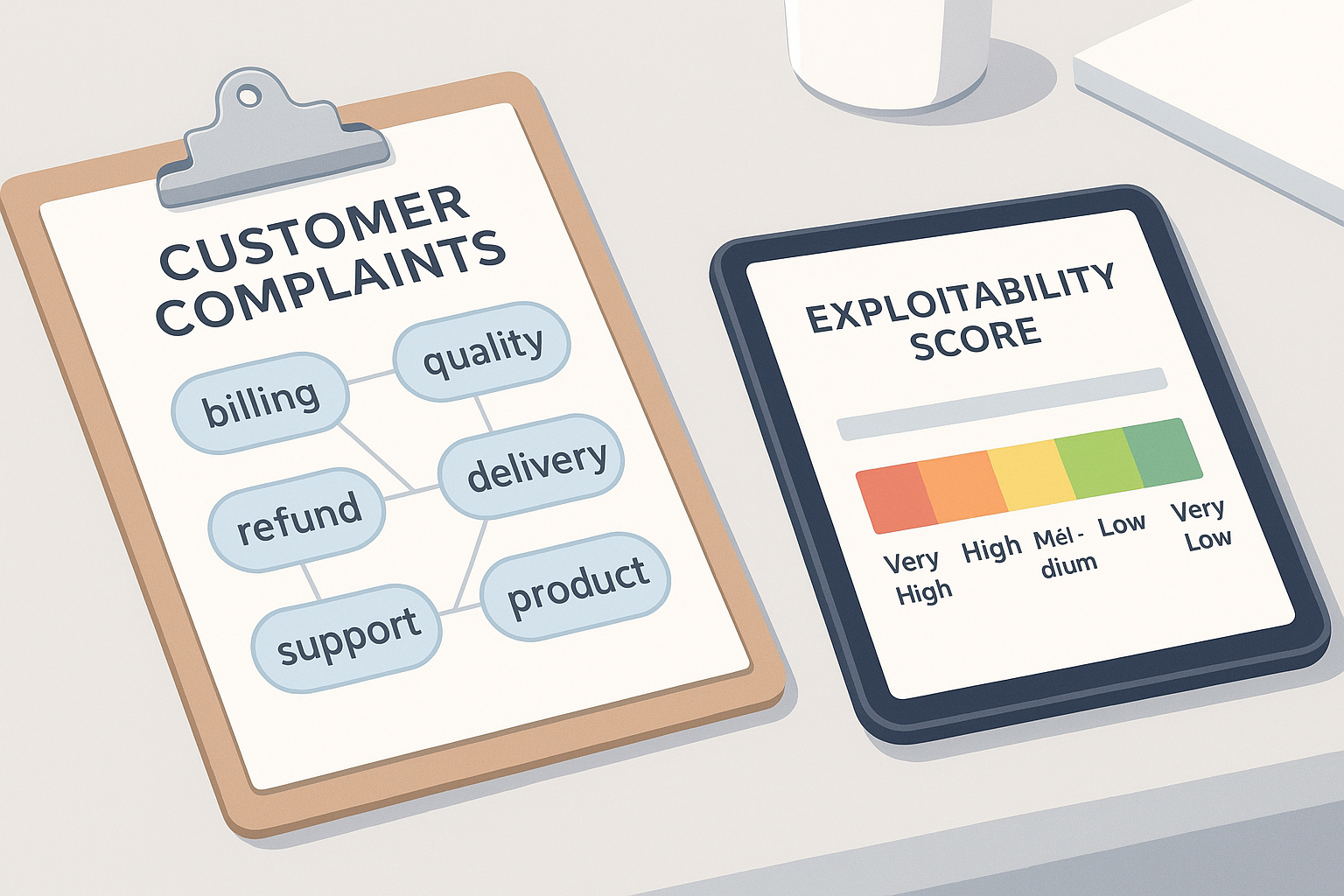
Grouping complaints into named themes turns scattered reviews into a usable marketing roadmap.
Common Complaint Patterns in HVAC Reviews
Across most local markets, the same handful of weakness themes appear again and again. Surprise charges top the list, where a customer says the quoted price on the phone did not match the final bill. Missed or widened arrival windows come next, often described as "waited all day, nobody called."
In addition, rushed installs, callbacks that never happen, messy jobsite cleanup, pushy equipment upsells, and warranty runarounds all show up repeatedly. Because these themes reflect operational habits rather than isolated bad luck, they tend to persist for months or years inside a competitor's review history, which makes them reliable targets for your own messaging.
Turning HVAC Competitive Intelligence Into Campaign Copy
Finding the weakness is only half the job. The other half is writing copy that speaks directly to the frustration without ever naming a competitor, since doing so creates both legal risk and platform policy problems.
For example, if a weakness theme is "missed arrival windows," the resulting Google Ads headline might simply promise "On-Time Arrival or $50 Off," validated against the 30 and 90 character limits. Similarly, a Meta ad built around "no surprise charges" would stay within the 40, 125, and 25 character field limits so it drops straight into an ad account without edits. You can see finished examples of this approach in HVAC Google Ads examples that actually win customers and in a full set of ready-to-run frameworks at HVAC marketing campaign templates that convert fast.
Backfire Protection: Check Your Own Reviews First
Before any angle goes live, it is worth running your own Google reviews through the exact same analysis you just applied to competitors. If your own customers also complain about late arrivals, a "we show up when we say we will" campaign invites a comparison you would lose.
This step, sometimes called backfire protection, is the fastest way to stop wasting ad budget on a claim your own reviews quietly contradict. Platforms that specialize in competitive intelligence, the structured practice of gathering public information about rivals, treat this check as a required step rather than an afterthought, because a campaign that backfires costs more than one that never runs at all.
Good hvac competitor analysis ends with finished campaign copy, not just a list of findings.
Doing It Yourself vs. Using a Managed Service
Owners can absolutely run this process manually, though reading thousands of reviews across five competitors tends to take a full day or more each month. For that reason, many agencies and owners now use managed services that automate the reading, clustering, and scoring steps.
As one example, WeakSpot monitors up to five chosen competitors, reads their entire review history rather than just the highlights, and delivers a monthly intelligence report plus a finished campaign pack, including Google Ads, Meta ads, Google Business Profile posts, and SEO briefs. Every engagement starts with a free self-analysis of your own reviews, emailed within two business days with no call required, and it does not run ads on your behalf; you or your agency keep control of the accounts.
Frequently Asked Questions
What is HVAC competitor analysis?
HVAC competitor analysis is the process of studying rival heating and cooling companies in your service area, including their pricing, marketing, and customer feedback, to find gaps you can compete on. The most useful version goes beyond star ratings and reads the actual complaint text inside negative reviews.
How do I do an HVAC competitor analysis myself?
Start by listing your top five local competitors, then read every one-to-three-star Google review they have received. Group the complaints into themes, such as late arrivals or surprise fees, and note which ones appear most often.
Why do most HVAC companies have similar star ratings?
Local HVAC companies tend to cluster between 4.8 and 5.0 stars because satisfied customers leave quick five-star reviews while only a small share of unhappy customers write detailed negative ones. A 4.9 average with 1,000 reviews can still hide thirty or more one-to-three-star complaints.
What is backfire protection in HVAC competitor analysis?
Backfire protection means checking your own reviews for the same complaint before you build a campaign around a competitor's weakness. If your customers also mention late arrivals, a "we show up on time" ad invites a comparison you could lose.
How many HVAC competitors should I analyze at once?
Most local HVAC owners get a clear picture from three to five direct competitors in their service area. Tracking more than that rarely adds new complaint patterns and makes the data harder to act on quickly.
What complaint themes show up most often in HVAC reviews?
Common themes include surprise charges not mentioned on the phone, missed or widened arrival windows, rushed installs, callbacks that never happen, and pushy equipment upsells. These patterns repeat across markets because they reflect operational habits, not bad luck.
How much does HVAC competitor analysis cost?
Doing it manually costs only your time, though reading thousands of reviews by hand can take days. Managed services like WeakSpot start at $149 per month for monitoring, with a $299 per month plan that adds full campaign copy and a backfire check.
How long does it take to see results from competitor analysis?
A manual review of two or three competitors' complaint history can take a few hours to a full day. Automated tools typically return a finished report within two business days of a request.
Can I mention a competitor's complaints directly in my ads?
No, naming a competitor directly creates legal and reputational risk and usually violates ad platform policies. Instead, write copy around the underlying frustration itself, such as promising upfront pricing, without identifying who the complaint came from.
What's the difference between competitor analysis and competitive intelligence?
Competitor analysis is usually a one-time snapshot of a rival's strengths and weaknesses. Competitive intelligence is an ongoing process that tracks changes over time, such as new complaint surges or rating drops, so your marketing stays current.
How often should I repeat HVAC competitor analysis?
Monthly reviews work well for most local HVAC markets because review volume and complaint patterns shift as seasons change. A busy summer cooling season, for example, often produces different complaints than a slow winter month.
What mistakes do HVAC owners make when analyzing competitors?
The most common mistake is only looking at the overall star rating instead of reading the actual review text. A close second is building a campaign around a weakness without first checking whether your own company shares that same flaw.
Final Thoughts
In the end, HVAC competitor analysis works because it turns public, ignored data into a specific plan rather than a vague sense that "we should market better." Every weakness theme you uncover traces back to a real customer's own words, which makes the resulting ad copy harder to dismiss and easier to trust.
Therefore, whether you read the reviews by hand or use a service built for it, the owners who act on this information consistently pull ahead of competitors still competing on price alone. You can see the broader approach applied across home-service trades at weakspot.io/home-services, or start with a free self-analysis of your own reviews at weakspot.io to see exactly where your own company stands before you build the next campaign.
