
Competitor Google reviews monitoring is the practice of tracking and reading everything your local rivals' customers write on Google, not just the star average sitting at the top of their profile. For home service businesses in Dallas-Fort Worth, a plumber or roofer sitting at 4.9 stars can still carry thirty to fifty detailed complaints about missed arrival windows, surprise charges, or rushed installs. Those reviews are public and specific, yet almost nobody reads the full set. This guide explains what competitor Google reviews monitoring actually involves, how to do it step by step, and how to turn what you find into messaging instead of another spreadsheet nobody opens.
Direct answer: Competitor Google reviews monitoring means tracking every review a rival business receives over time, isolating the negative ones, and grouping repeated complaints into clear patterns. Instead of comparing star ratings, you compare the specific reasons customers left unhappy, which is where the real competitive gap usually lives.
What Is Competitor Google Reviews Monitoring?
Competitor Google reviews monitoring means systematically reading, sorting, and categorizing the reviews posted on your competitors' Google Business Profiles, the free online listing Google provides for local businesses, rather than glancing at a star rating once and moving on. In practice, this means pulling every review for each tracked competitor, separating the one, two, and three star reviews from the glowing ones, and looking for complaints that repeat.
A single bad review might be an outlier. However, when five or ten customers independently describe the same problem, such as an installer leaving a mess behind, that is no longer an outlier. It is a pattern, and patterns are far more useful for marketing than a single anecdote.
For a broader look at how review platforms shape consumer decisions, Wikipedia's overview of online reviews explains the role they play in modern purchase decisions across industries, not just home services.

Reading the full review set, not just the star average, is the starting point of competitor Google reviews monitoring.
Why Star Ratings Hide the Real Competitive Gap
In most local home service markets, every serious competitor looks nearly identical on paper. Plumbers, roofers, HVAC companies, and residential electricians frequently sit between 4.8 and 5.0 stars, which leaves owners competing on price and ad spend because there appears to be nothing else to differentiate on.
A star rating, however, is only an average. A competitor with a 4.9 rating built on 1,500 reviews can still have thirty to fifty customers who wrote down exactly why they were unhappy. Comments such as "quoted one price, billed another" or "waited all day, nobody called" are specific, searchable, and almost always ignored by the very businesses competing against them.
As a result, the home service businesses that actually read this data gain a messaging advantage that has nothing to do with outspending anyone on ads.
How to Monitor Competitor Google Reviews in 5 Steps
Setting up competitor Google reviews monitoring does not require special software, though it does require consistency. Here is a practical process any home service owner can follow:
- Pick three to five direct competitors. Choose the businesses you actually lose jobs to most often, not every company listed under your trade category.
- Pull the full review history. Collect every review each competitor has ever received instead of only the most recent twenty, since older complaints often describe problems that never got fixed.
- Separate negative reviews from the average. Isolate the one, two, and three star reviews so you can read the actual complaint instead of relying on a blended score.
- Group complaints into weakness themes. Cluster similar complaints together, such as missed arrival windows or surprise fees, and note how often each theme repeats.
- Check your own reviews before acting. Run the same process on your own business first so you never build a campaign around a complaint your own customers share too.
Doing this manually for even three competitors with a thousand reviews each takes real hours every month. That is the gap services built around competitive intelligence for home service businesses are designed to close.
Weakness Themes Hiding Under a 4.9 Star Average
Once negative reviews are grouped, clear weakness themes usually emerge. In home services, the same handful of patterns show up again and again, across plumbing, roofing, HVAC, and electrical reviews alike.
| Weakness Theme (Illustrative) | Example Complaint Pattern | Exploitability Score |
|---|---|---|
| Surprise charges | "Quoted a flat fee over the phone, charged extra on arrival." | 8/10 |
| Missed arrival windows | "Said morning, showed up after six with no call." | 7/10 |
| Rushed or messy jobs | "Finished fast but left drywall dust across the hallway." | 6/10 |
| Warranty runarounds | "Covered under warranty on paper, took three calls to schedule." | 7/10 |
Examples above are illustrative composites, not quotes from any specific business.
In particular, the exploitability score matters because not every complaint is worth building a campaign around. A theme that appears once in 1,500 reviews is noise. One that repeats across dozens of reviews, in contrast, describes something structural about how that competitor operates.
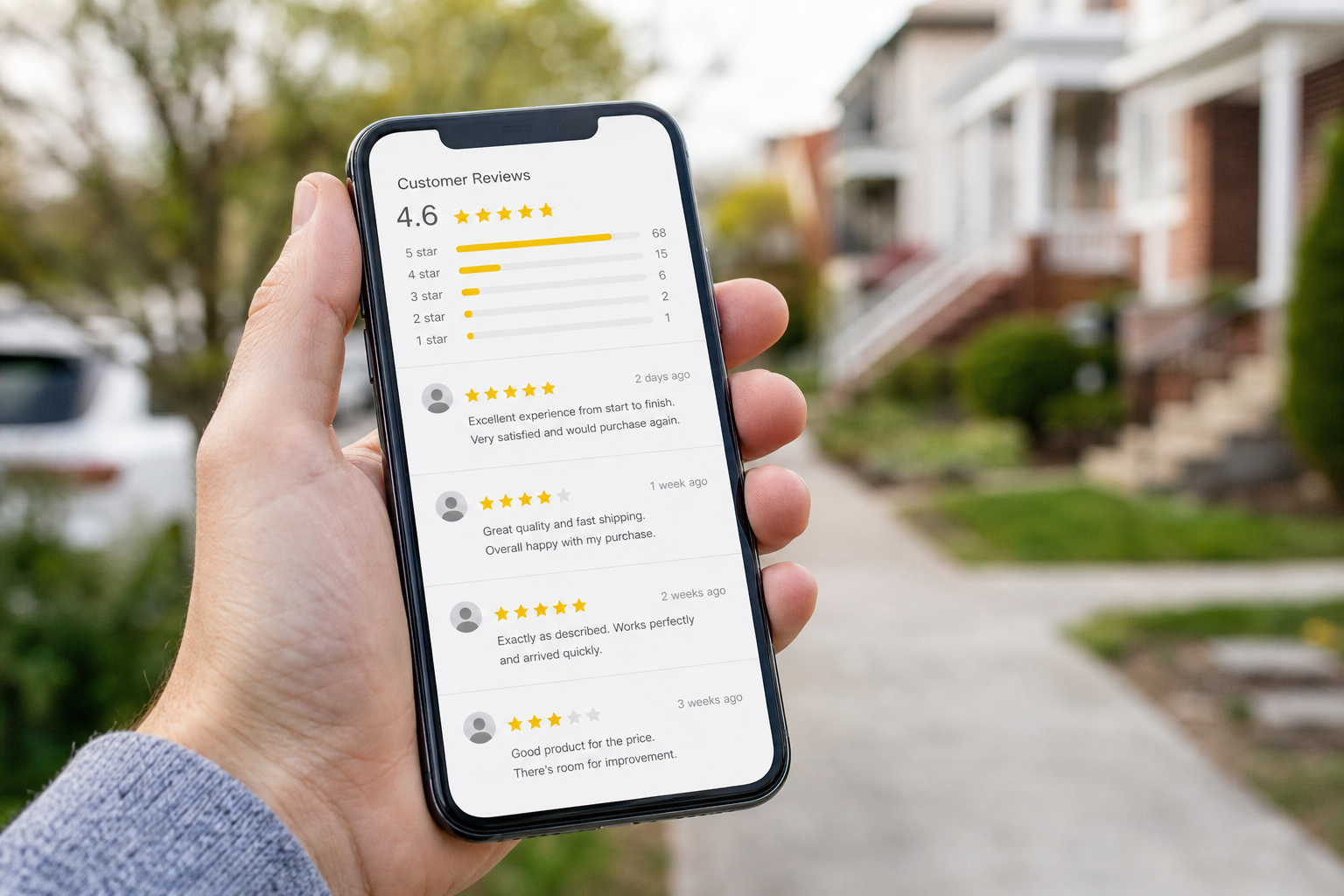
Grouping individual complaints into repeatable weakness themes is what turns scattered reviews into usable intelligence.
From Review Monitoring to Campaign Copy
Finding a weakness theme is only half the job. The harder, more useful step is turning that pattern into copy that runs somewhere: a Google Ads headline, a Google Business Profile post, or an email subject line.
For example, if missed arrival windows show up repeatedly across a competitor's one and two star reviews, that becomes the basis for a headline validated against Google's 30 and 90 character field limits, or a Meta ad built within the 40, 125, and 25 character limits for headline, body, and description. The campaign never names the competitor directly. It simply speaks to the frustration the next customer in that market is already trying to avoid.
If you want a deeper walkthrough of this process, the guide on finding competitor weaknesses in local service markets breaks down the research side in more detail, while the piece on turning rival reviews into campaign material covers the copywriting side.
Backfire Protection: Check Your Own Reviews First
Before any competitor-based angle goes live, it needs to pass one more test. If your own reviews also mention late arrivals, a "we show up when we say we will" campaign invites a comparison you are likely to lose. This check is sometimes called backfire protection, and skipping it is one of the fastest ways to waste ad budget on a claim your own customers would dispute.
Consequently, the same negative review analysis applied to competitors should also be applied to your own business before any campaign ships. It is a short extra step that prevents a much larger, more public problem later.
The approach echoes guidance the Federal Trade Commission has published on honest advertising claims. The agency's endorsement guidance makes clear that claims a business makes about itself need to hold up under scrutiny, which is exactly what a self-check accomplishes before a campaign runs.
Setting Up Ongoing Competitor Review Monitoring
Monitoring is not a one-time project. New reviews post every week, which means a weakness theme that looked small three months ago can grow, and a competitor who recently fixed a recurring problem can quietly close a gap you were planning to use.
Google's own guidance for business owners on managing their Business Profile, available through Google Business Profile Help, confirms that reviews post continuously and can be filtered by rating, which supports the kind of ongoing tracking this process requires.
For home service owners who want a structured option rather than manual tracking, WeakSpot monitors up to five chosen competitors and refreshes the analysis monthly. The Weak Spot Intel plan runs 149 dollars a month for two competitors with a monthly intelligence report and watch list alerts. Market Edge, the most popular option at 299 dollars a month, tracks five competitors and adds a full campaign pack along with a monthly self-analysis and backfire check on your own reviews. Both paid plans include a guarantee: if the first report does not surface at least three exploitable weaknesses, that month is free. Every engagement starts the same way, with a free self-analysis of your own reviews, emailed within two business days with no call required.

Ongoing competitor Google reviews monitoring works best when the findings reach the people running campaigns, not just a dashboard.
Putting It to Work in Your Own Market
None of this requires naming a competitor in an ad or picking a fight you cannot win. Specifically, the goal is to speak directly to a frustration the next customer in your market already has, using language pulled from what real customers actually wrote.
Similarly, this approach works whether you run campaigns yourself or hand finished copy to an outside agency. The research and writing happen first, and whoever manages your ad accounts simply drops the copy in. For more on applying this across a full local strategy, see the guides on positioning against competitors using Google reviews and home services competitive analysis.
If you manage review tracking manually today, the piece on review monitoring for contractors walks through how to spot the easy wins first before expanding to a full monitoring setup.
Frequently Asked Questions
What is competitor Google reviews monitoring?
Competitor Google reviews monitoring is the ongoing practice of tracking and reading every review your competitors receive on Google, not just their star average. It involves sorting reviews by rating, isolating the one to three star complaints, and finding repeated patterns in what unhappy customers wrote.
How does competitor Google reviews monitoring work?
It starts by pulling the full review history for each competitor you choose, then separating negative reviews from positive ones. From there, the negative reviews get grouped into recurring complaint types, such as missed appointment windows or surprise fees, so a clear pattern emerges.
Why should home service businesses monitor competitor reviews?
Home service businesses often compete in markets where every serious rival sits between 4.8 and 5.0 stars, making price and ad spend the only visible differentiators. Monitoring competitor reviews uncovers the specific frustrations hiding under those averages, giving owners something more concrete to message against.
How is competitor Google reviews monitoring different from checking star ratings?
Checking a star rating gives a single blended number that hides the detail inside it. Competitor Google reviews monitoring reads the actual text of every review so specific, recurring complaints become visible instead of staying buried under a high average.
How much does a competitor Google reviews monitoring service cost?
Pricing varies by provider and the number of competitors tracked. WeakSpot's plans start at 149 dollars a month for two competitors with a monthly report, and 299 dollars a month for five competitors with a full campaign pack and monthly self-analysis.
How long does it take to see results from monitoring competitor reviews?
A free self-analysis of your own reviews typically arrives within two business days of submitting your business details. Ongoing competitor reports are then delivered monthly as new reviews accumulate and new weakness themes emerge.
What common mistakes do owners make when reading competitor reviews?
The most common mistake is only glancing at the star rating and skipping the written reviews entirely. Owners also tend to read a handful of recent reviews instead of the full history, which means older but still relevant complaint patterns get missed.
What is a weakness theme in competitor review analysis?
A weakness theme is a named, recurring complaint pattern found across multiple negative reviews, such as surprise charges or rushed jobs. Each theme can be scored for how exploitable it is and backed by direct quotes from customers.
How many competitors should I track with review monitoring?
Most home service owners get useful results tracking three to five direct competitors in their service area. Tracking too many dilutes focus, while tracking too few can miss an emerging pattern at a fast-growing rival.
What is backfire protection and why does it matter?
Backfire protection means checking your own reviews for the same complaint before you run a campaign calling it out in a competitor. If your business also struggles with late arrivals, a campaign promising on-time service invites a comparison you would lose.
Can competitor Google reviews monitoring guarantee more leads or higher rankings?
No credible monitoring service can guarantee rankings, revenue, or lead volume, since those outcomes depend on many factors outside review data. What monitoring can reliably provide is specific, evidence-backed messaging angles that you or your agency can test.
Does competitor Google reviews monitoring work for industries besides home services?
The underlying method of reading and clustering negative reviews can apply broadly, but it works especially well in local, appointment-based trades where star ratings cluster tightly. Plumbing, roofing, HVAC, and electrical services are strong fits because competitors often look nearly identical on the surface.
How do I start monitoring competitor Google reviews today?
A practical first step is running a free self-analysis on your own Google reviews before looking at competitors, so you know your own weak spots first. From there, you can choose a monitoring plan that tracks a handful of direct rivals in your service area.
Final Thoughts
In the end, competitor Google reviews monitoring is less about spying on rivals and more about reading data that has been public all along. Every business with a Google Business Profile already has thirty, fifty, or a hundred unhappy customers who wrote down exactly what went wrong. Therefore, the advantage goes to whoever actually reads them, groups the patterns, and checks their own reviews before making a claim.
Whether you build this process by hand or use a structured service, the goal stays the same: find what is under the stars, turn it into honest, specific messaging, and skip the guesswork that comes from comparing star ratings alone. You can see this in action with a free self-analysis at WeakSpot, or review a live demo at app.weakspot.io/demo before choosing a plan.