
Competitor Bad Reviews Marketing: Turn Complaints Into Leads
Competitor bad reviews marketing is the practice of reading every negative review your competitors have ever received, finding the complaint patterns hiding under their 4.8 or 4.9-star averages, and converting those patterns into ad copy, Google Business Profile posts, and email hooks that speak directly to the next frustrated customer. In crowded local markets like plumbing, roofing, and HVAC, almost every serious competitor looks nearly identical on the surface. However, a star rating is only an average, and averages hide a lot. Underneath a glowing 4.9, there are usually thirty or more one and two-star reviews describing, in the customer's own words, exactly why they left.
This guide walks through what competitor bad reviews marketing actually is, how to find the weaknesses worth using, and how to protect your own campaigns from backfiring. As a reference point throughout, we will draw on the methodology used by weakspot.io, a service built specifically for this purpose.
Competitor bad reviews marketing starts by looking past the average rating.
What Is Competitor Bad Reviews Marketing?
Competitor bad reviews marketing is a strategy that turns verified complaints from a rival's Google reviews into targeted marketing messages, without ever naming the competitor directly. Instead of guessing what frustrates customers in your market, you read the reviews where they already said it out loud, then address that exact frustration in your own ads and posts.
This works because online reviews are public record. In fact, the Federal Trade Commission's 2024 rule banning fake and deceptive reviews underscores just how much weight regulators and consumers place on genuine review data. A line like "they never showed up for the second appointment" is not an opinion. It is a documented grievance that likely repeats itself across dozens of reviews for the same company, and that repetition is what makes it usable.
Why Every Local Service Business Looks the Same on Paper
In almost every local market, serious competitors cluster between 4.8 and 5.0 stars. On the surface, there is nothing to separate them, so owners end up competing on price, on ad spend, or on who shouts loudest in search results. Consequently, the owner who wants to grow ends up paying more for the same clicks as everyone else.
A Pew Research Center survey found that 82% of U.S. adults at least sometimes read online reviews before buying something for the first time. As described on Wikipedia's overview of online reviews, review platforms function as word-of-mouth at scale. That trust is exactly why a documented complaint carries more weight than any ad claiming to be "the best."
A competitor with 1,500 reviews and a 4.9 average still has somewhere between thirty and fifty one, two, and three-star reviews. Specifically, those reviews describe the frustration the next customer in that market is actively trying to avoid, whether that is a surprise charge, a missed arrival window, a rushed install, or a callback that never comes. Almost nobody reads closely enough to act on what they say, which is precisely the gap this strategy fills. Our guide to competitive intelligence for local businesses covers this idea in more depth.
How to Turn Competitor Complaints Into Campaign Copy
Turning a scattered pile of one-star reviews into usable marketing copy follows a fairly consistent process. Below is the sequence that works whether you do it manually or use a service to automate it.
- Pick three to five direct competitors in your exact service area, since a weakness from a business outside your market will not resonate with your local customers.
- Pull each competitor's entire Google review history, not just the most recent or most helpful reviews, because older complaints often repeat for years without being fixed.
- Isolate the one, two, and three-star reviews, then group them into repeating themes such as surprise charges, missed arrival windows, rushed jobs, or warranty runarounds.
- Score each theme from one to ten for how exploitable it is, and attach verbatim quotes so the pattern is undeniable rather than a vague impression.
- Run your own reviews through the identical process before writing a single word of copy, since a theme you share with the competitor will backfire.
- Write the strongest, safest themes into Google Ads headlines, Meta ad copy, Google Business Profile posts, and email hooks that fit each platform's character limits.
For a deeper breakdown of this exact workflow, see our post on turning competitor weakness analysis into qualified leads.
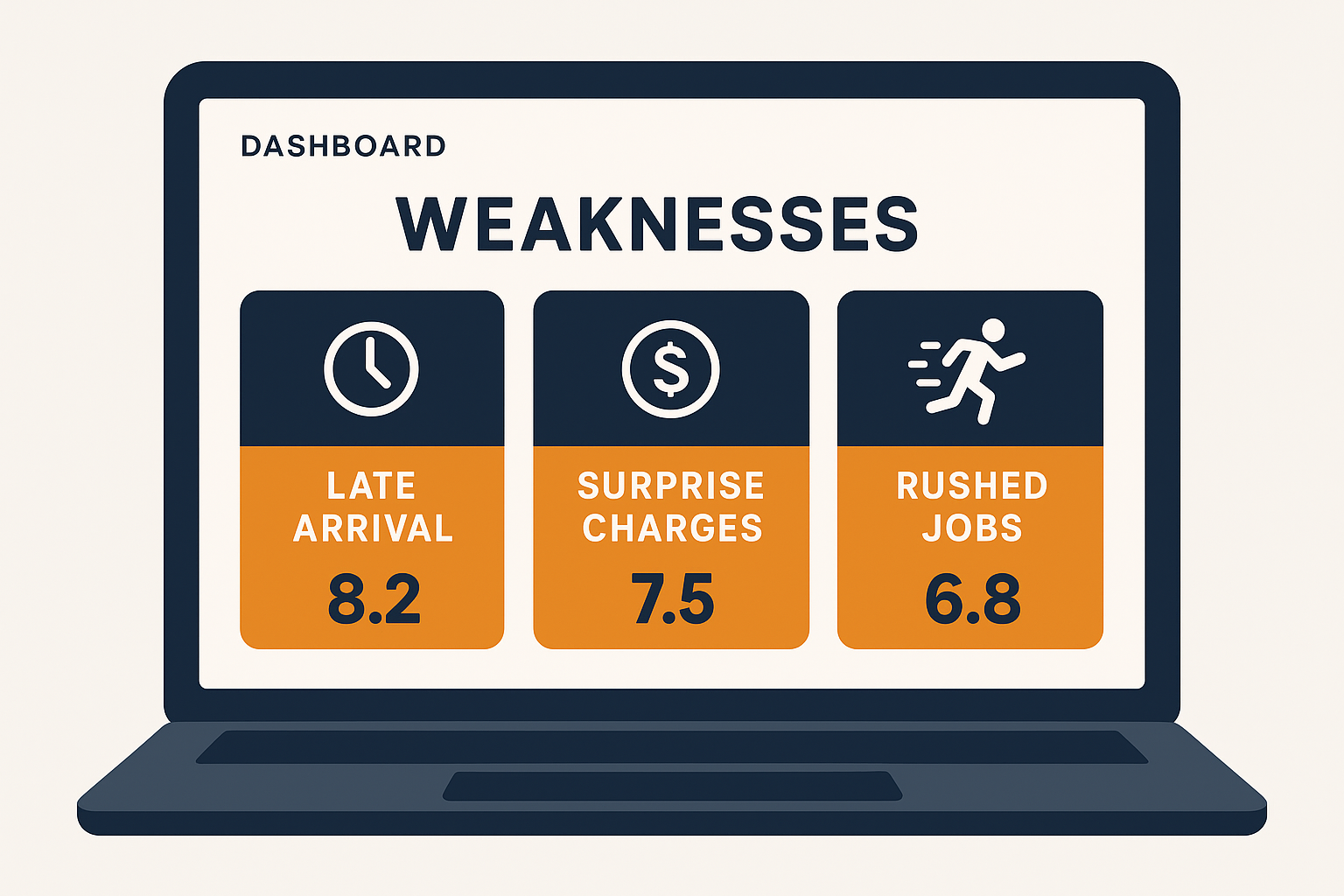 Scoring each weakness theme turns raw complaints into a prioritized campaign plan.
Running a Backfire Check Before You Publish Anything
Before any angle reaches a campaign, it needs to survive one more test. If your own reviews also mention late arrivals, a "we show up when we say we will" headline invites a comparison you would lose. This step, often called a backfire check, is the fastest way to stop wasting ad budget on claims your own reviews contradict.
In practice, this means every weakness theme gets checked twice: once against the competitor's reviews to confirm it is real and repeating, and once against your own reviews to confirm it is safe to claim. Only themes that pass both checks become part of a finished campaign. Our post on turning competitor negative reviews into leads walks through several real examples of this process in action.
A Short Example
"Tech showed up three hours late and never apologized." This is the kind of verbatim line that, once it appears across a dozen competitor reviews, becomes a safe and specific angle: a guaranteed arrival window, stated plainly, backed by a business that has already confirmed through its own backfire check that lateness is not one of its documented problems.
What a Monthly Intelligence Report Should Include
Not every competitive intelligence offering delivers the same depth. For example, WeakSpot structures its plans around two different levels of output, shown below.
| Plan | Competitors tracked | Includes |
|---|---|---|
| Weak Spot Intel ($149/mo) | 2 | Monthly intelligence report and watch list alerts |
| Market Edge ($299/mo) | 5 | Full report, complete campaign pack, monthly self-analysis, and backfire check |
Market Edge and higher plans also carry a guarantee: if the first report fails to surface at least three exploitable weaknesses across your competitors, that month is free. For more on comparing approaches and proven tactics for this kind of market positioning, see proven tactics for winning customers from competitors.
Where This Copy Runs Once It's Finished
Finished campaign copy only matters if it fits the platform it runs on. Google Ads headlines, for instance, must stay within 30 and 90 character limits, while Meta ad copy needs to fit within 40, 125, and 25 character fields for the headline, primary text, and description respectively. Google Business Profile posts, SEO content briefs, and email subject lines each come with their own constraints as well.
In other words, the analysis is only half the job. The other half is formatting every weakness-based message so it drops straight into an existing ad account without rework. You or your agency keep full control of the accounts; the intelligence provider simply hands over copy that is ready to paste in. You can see this process firsthand through the live demo at app.weakspot.io/demo.
 Finished campaign copy means the team can run it the same day it arrives.
Frequently Asked Questions About Competitor Bad Reviews Marketing
What is competitor bad reviews marketing?
Competitor bad reviews marketing is the practice of reading a rival's public Google reviews, finding repeated complaint patterns, and turning those patterns into campaign copy that appeals to the next unhappy customer. It relies on verbatim quotes instead of guesswork.
How do you find a competitor's weak points from their reviews?
You read their entire review history, not just the top results, and isolate the one, two, and three-star reviews. Grouping those into repeating themes, such as missed arrival windows or surprise charges, reveals the patterns a star rating hides.
Why do businesses with 4.9-star ratings still have exploitable weaknesses?
A star rating is an average. A company with 1,500 reviews and a 4.9 average can still have thirty to fifty negative reviews describing specific, recurring frustrations that a star count never shows.
What is a backfire check and why does it matter?
A backfire check runs a business's own reviews through the same complaint analysis used on competitors before any campaign ships. If the business shares the same weakness, that angle is flagged so it never invites a losing comparison.
Is it against platform rules to use competitor reviews in ads?
Reviews on Google and other platforms are public information, so reading them is not a policy violation. The safer practice is to build campaign copy around the complaint theme itself and never name the competitor directly in the ad.
Does campaign copy built this way name competitors directly?
No. Responsible competitor bad reviews marketing addresses the frustration, such as surprise charges or missed arrival windows, without naming the business that earned the complaint. This keeps the messaging defensible and focused on the customer's experience.
Final Thoughts
Competitor bad reviews marketing works because it replaces guesswork with evidence. Instead of competing on price or outspending rivals on ads, a business can read the exact words frustrated customers already used and address that frustration before the next buyer even asks. The process is straightforward: find the full review history, isolate the complaints, score the themes, check your own reviews for the same problem, then write copy that fits the platform you plan to run it on.
Ultimately, the businesses that win this way are not the loudest or the cheapest. They are the ones willing to read what everyone else skipped. If you want to see what this looks like for your own market, you can start with a free self-analysis at weakspot.io and request results within two business days.
