
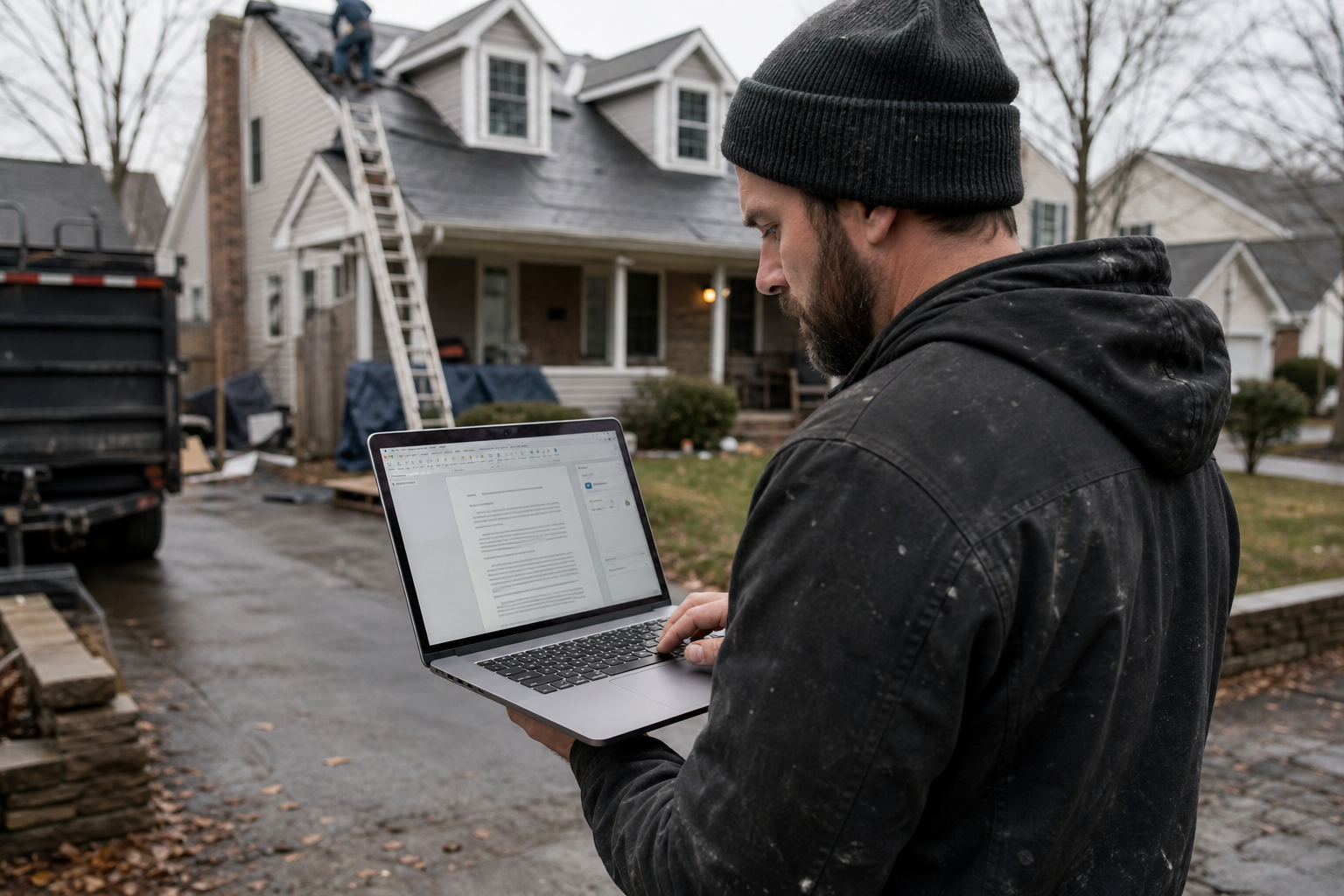
Roofing Competitor Analysis: Find Rivals' Weak Spots
Roofing competitor analysis is the practice of studying the roofing companies competing for the same jobs you want, then reading what their customers actually say once the invoice is paid. Most roofing contractors in a given market sit within a few tenths of a star of each other, somewhere between 4.7 and 5.0. On the surface, that makes every competitor look interchangeable. However, a star rating is just an average, and averages hide a lot. A company with 1,200 reviews and a 4.9 average still has dozens of customers who left one, two or three stars and explained exactly why. This guide walks through how a proper roofing competitor analysis works, what weakness themes tend to show up in roofing reviews, and how a roofing company can turn those patterns into usable marketing copy instead of another spreadsheet.
Short answer: Roofing competitor analysis means reading every public review a competing roofer has collected, not just the average star rating, to find specific, repeated complaints you can address better. The goal is to surface patterns like missed arrival windows or surprise charges, then check your own reviews for the same problems before you build any marketing around them.
What Is Roofing Competitor Analysis?
Roofing competitor analysis is the process of reading a competing roofing company's full review history, isolating the negative reviews, and grouping repeated complaints into named weakness themes. Instead of guessing why a rival loses customers, you read their own customers' words for the answer.
Most roofing owners already glance at a competitor's star rating before a big push. Few actually scroll past the five-star reviews to read the ones buried at two and three stars. That is where the detail lives. A homeowner who writes "quoted one price, got billed for extra felt and flashing nobody mentioned" is handing you a specific, provable frustration. In addition, a cluster of reviews mentioning missed arrival windows or a crew that never called back tells you something a star rating never will. Because roofing is a high-ticket, trust-dependent purchase, these specifics matter more than they would for a smaller transaction. Therefore, a serious roofing competitor analysis treats every one, two and three-star review as a data point, not noise, and groups them into themes such as surprise charges, rushed jobs, or warranty runarounds that repeat often enough to be useful.
A roofing competitor analysis starts with reading reviews, not guessing at ratings.
Why Every Roofing Company Looks the Same on Paper
Walk through any mid-size metro and pull up five roofing companies on Google. Chances are all five sit between 4.7 and 5.0 stars with hundreds, sometimes thousands, of reviews. On paper, that makes differentiation nearly impossible, so owners end up competing on price or on who spends more per click. However, that sameness is mostly an illusion created by averages.
A business with 1,500 reviews and a 4.9 rating still has somewhere around 30 to 75 reviews sitting at one, two or three stars, each one written by someone who was annoyed enough to say so in public. The Federal Trade Commission's consumer protection guidance notes that online reviews heavily shape purchase decisions, which is part of why the agency has worked to keep review data honest. For a roofing company, that means the handful of bad reviews a rival has collected are not just complaints, they are public, specific, and searchable. Nobody reads all of them. That gap is exactly where a focused roofing competitor analysis earns its keep, because it surfaces what the top-line rating cannot.
How to Analyze Roofing Competitors Step by Step
Running a thorough competitor review analysis does not require special software, though it does require patience. Here is the process behind a roofing competitor analysis, broken into six steps:
Pick up to five direct competitors. Choose roofing companies in your same service area that bid on similar jobs, not national chains with a different customer base.
Pull the full review history, not the highlights. Read every Google review each competitor has ever received, including older reviews, since weakness patterns often repeat across several years.
Isolate the one, two and three-star reviews. These are the reviews most likely to contain specific, provable complaints instead of generic praise.
Group complaints into named weakness themes. Cluster repeated phrases, such as missed arrival windows or unexpected fees, into themes you can score and back with direct quotes.
Score each theme for how exploitable it is. A theme repeated across dozens of reviews and multiple competitors is more useful than a single angry outlier.
Check your own reviews for the same problems. Confirm your own customers are not describing the same issue before building a campaign around a competitor's weakness, since that would undercut the message.
Turning Competitor Review Analysis Into Campaign Copy
Once the weakness themes are scored and backed by verbatim quotes, the real work starts: turning research into copy someone will actually run. A theme like "arrived outside the promised window" can become a Google Ads headline, a Google Business Profile post, or an email subject line, all without ever naming the competitor. Specifically, every line has to fit inside the platform's character limits, 30 characters for a standard Google Ads headline and 90 for a long one, and 40, 125 and 25 characters for the three Meta ad fields.
For roofing companies looking for more structured starting points, this roundup of roofing marketing ideas built to outrank 4.9-star rivals covers campaign angles in more depth, and this guide on proven strategies to get more roofing leads pairs well with a sharper competitive message. The point of a roofing competitor analysis is never the report itself. It is the headline that runs on Monday.

Weakness themes come from reading the reviews, not scanning the star average.
Backfire Protection: Check Your Own Reviews First
Here is the step most competitor research skips entirely. Before any weakness theme reaches a campaign, it has to survive one more check: does your own roofing company have the same problem? If a handful of your own reviews mention late arrivals, running a "we show up when we say we will" campaign invites a side-by-side comparison you would lose.
This step is called backfire protection, and it runs your own review history through the identical analysis used on competitors. As a result, every message that reaches a finished campaign pack is one you can defend if a customer checks for themselves. This matters more in roofing than in almost any other home-service category, because a roof replacement is a five-figure decision and homeowners tend to research harder before signing. In short, backfire protection is not an extra feature bolted on for marketing. It is the difference between a claim that holds up and one that gets screenshotted and used against you.
Roofing Competitive Intelligence in Dallas-Fort Worth
This kind of research started in Dallas-Fort Worth, where roofing is one of the most competitive home-service categories in the country. Hailstorms roll through North Texas most springs, which means a wave of new roofing companies appears every storm season, and established roofers suddenly have dozens of new competitors bidding on the same jobs. In a market like that, roofing competitive intelligence is less of a luxury and more of a baseline.
For example, a roofer tracking five competitors across Dallas, Fort Worth, Arlington and the surrounding suburbs can see which rivals have a cluster of complaints about delayed insurance paperwork or rushed tear-offs, then build messaging around the opposite. The same approach applies across other home-service trades in the metro. Plumbing and HVAC companies in DFW face a nearly identical problem of look-alike star ratings, covered in more detail in this plumbing competitor analysis tool guide and this breakdown of HVAC competitor analysis for uncovering rivals' weak spots. The full list of trades supported for this kind of research is on the home services page, and background on the industry itself is available through the National Roofing Contractors Association.

A monthly report turns scattered reviews into a short list of exploitable patterns.
Choosing a Plan for Ongoing Roofing Competitor Research
Running a one-time roofing competitor analysis is useful, but weakness themes shift as competitors earn new reviews and lose old customers. Because of this, ongoing monitoring tends to matter more than a single snapshot. Below is how the current plans break down.
Plan | Competitors Tracked | Includes | Price |
|---|---|---|---|
Weak Spot Intel | 2 | Monthly intelligence report, watch list alerts | $149/month |
Market Edge (most popular) | 5 | Monthly report, full campaign pack, self-analysis and backfire check refreshed monthly, watch list | $299/month |
Market Takeover | See weakspot.io | Built for companies wanting the deepest coverage | See weakspot.io |
Market Edge and Market Takeover both include a guarantee: if the first report does not surface at least three exploitable weaknesses across your tracked competitors, that month is free. Every plan starts the same way, though. Submit a business name, a website or Google Maps link and a business email at weakspot.io for a free self-analysis of your own reviews, emailed within two business days, no call required.
Frequently Asked Questions About Roofing Competitor Analysis
What is roofing competitor analysis?
Roofing competitor analysis is the process of reading a competing roofing company's full set of Google reviews, especially the one to three star reviews, to find specific, repeated complaints. Those patterns, called weakness themes, become the basis for marketing messages you can defend.
How do you start a roofing competitor analysis?
Start by picking up to five roofing companies that compete for the same jobs you do, then pull their complete review history rather than just the top reviews Google shows first. From there, group the negative reviews into themes and score how often each one repeats.
Why do most roofing companies have nearly identical star ratings?
Star ratings are averages, and a company with hundreds or thousands of reviews only needs a small percentage of unhappy customers to still land near 4.8 or 4.9. Because the math smooths out the complaints, two roofers can look identical on the surface while having very different problems underneath.
How is this different from just reading reviews manually?
Reading reviews manually works, but it is slow and easy to quit after a handful of pages. A structured analysis reads the entire history for every competitor, groups complaints into named themes, and scores each one so the patterns are obvious instead of scattered across hundreds of reviews.
What does a weakness theme look like in practice?
A weakness theme is a specific, repeated complaint, such as being quoted one price and billed for extra materials, or a crew that never called back after the install. Each theme is backed by verbatim quotes so the pattern is provable, not a guess about a competitor's reputation.
How much does WeakSpot's roofing competitor analysis cost?
Plans start at $149 a month for the Weak Spot Intel tier, which tracks two competitors with a monthly report. The Market Edge plan, the most popular option, runs $299 a month and tracks five competitors with a full campaign pack included.
How long does it take to get results?
The free self-analysis of your own reviews is emailed within two business days, with no call required. Full competitor reports and campaign packs follow a monthly cycle once a plan starts.
What mistakes do roofing companies make when researching competitors?
The most common mistake is only looking at a competitor's star rating instead of reading the reviews underneath it. Another frequent mistake is building a marketing message around a weakness without first checking whether your own company has the same problem.
What is backfire protection?
Backfire protection is the step where a company's own reviews are run through the same analysis used on competitors before any campaign ships. If your own customers describe the same complaint you planned to target, that angle gets flagged instead of published.
Does WeakSpot run my advertising campaigns?
No, WeakSpot delivers the research and the finished copy. You or your agency run the ads in your own Google Ads, Meta or Google Business Profile accounts, since WeakSpot is the intelligence, not the ad agency.
How many competitors should a roofing company track?
Most roofing companies get useful results tracking three to five direct competitors in their service area. Tracking too many can dilute the patterns, while tracking too few risks missing a theme that shows up across the wider market.
Is roofing competitor analysis only useful for paid ads?
No, the same weakness themes can shape Google Business Profile posts, SEO content briefs, email subject lines and how a sales team handles objections on the phone. Paid ads are just one place the research gets used.
Can campaign copy name a specific competitor?
No, campaign copy built from this kind of research should never name a competitor directly. It should focus on the behavior or promise, such as showing up on time, and a business should check local advertising rules before running direct comparisons.
The Bottom Line on Roofing Competitor Analysis
Every roofing company in a competitive metro can look the same on the surface, all parked between 4.7 and 5.0 stars with plenty of reviews to prove it. However, that sameness breaks down the moment someone reads the one, two and three-star reviews each competitor has collected over the years. A disciplined roofing competitor analysis turns those scattered complaints into named, scored weakness themes, backed by the customer's own words, then checks your own reviews for the same problems before anything gets published.
The result is not another dashboard to stare at. It is copy, not a chart, ready to run in your own accounts. If you want to see where to start, a free self-analysis of your own reviews is the first step, and it arrives in your inbox within two business days, no call required.