Google Ads Copy for Roofers: Headlines That Convert
Google Ads copy for roofers only works when it says something competitors cannot say, and most roofing ads fail that test before they ever launch. Walk through any local market and nearly every roofing company sits between 4.8 and 5.0 stars on Google. On the surface, there is nothing to tell them apart, so owners end up competing on price and ad spend instead of message. However, a star rating is only an average. Hidden underneath it are the one, two, and three-star reviews where real customers described exactly what went wrong, and that is where the next winning headline comes from.
Direct answer: Google Ads copy for roofers is the headline and description text that runs inside a roofing company's search campaigns. The strongest version is not pulled from a template. It is built from a specific competitor weakness, backed by a real review, that a roofer's own reviews do not share.
Writing google ads copy for roofers starts with reading the reviews competitors would rather you skip.
What Is Google Ads Copy for Roofers?
Google Ads copy for roofers is the combination of headlines, descriptions, and display paths that appear when a homeowner searches terms like "roof repair near me" or "emergency roof leak." Google's responsive search ad format allows up to 15 headlines at 30 characters each and 4 descriptions at 90 characters each, which Google then mixes and tests automatically, according to Google's own responsive search ads guidance.
In practice, most roofing companies fill those fields with the same four claims: licensed and insured, free estimates, 24-hour emergency service, locally owned. Consequently, none of it moves a homeowner staring at six nearly identical search results. The copy that actually earns a click answers an unspoken question already in that homeowner's head, usually shaped by a bad experience with a different contractor. Will this crew show up when they say they will? Will the quote match the final bill? Will anyone answer the phone if something leaks again after the install? Specifically naming the answer to one of those questions, in plain language, is what separates performing ad copy from a wall of adjectives.
Why Roofing PPC Ads All Sound the Same
Roofing PPC ads tend to collapse into the same handful of phrases because most copywriters start from a checklist of trust signals instead of a specific customer frustration. As a result, the paid results page for almost any "roof replacement" search looks like one company running six ads. That sameness is expensive. Roofing keywords already carry some of the highest cost-per-click rates in local service advertising, which means every wasted impression costs real money with nothing to show for it.
In addition, there is a well-documented reason generic claims underperform. Research from Northwestern University's Spiegel Research Center found that purchase likelihood peaks for ratings between 4.0 and 4.7 stars and drops as ratings approach a perfect 5.0, a sign that shoppers read past the star average. In other words, shoppers notice the complaints hiding behind a high rating. An ad that addresses the exact frustration behind those bad reviews, without ever naming who has them, is speaking directly to the fear already in a homeowner's mind. Generic copy ignores that fear. Specific copy answers it.
A 5-Step Process for Roofer Ad Copywriting
Turning a competitor's bad reviews into a working ad is a repeatable process, not a one-time brainstorm. Below is the sequence worth following for every new campaign or refresh.
- Pull your top five roofing competitors' Google reviews and isolate every 1 to 3 star review to find recurring complaint patterns like missed appointments or surprise pricing.
- Score each complaint theme for how common and how damaging it is, then pick the two or three weaknesses that appear most often across competitors.
- Check your own reviews for the same weakness before you write a single headline, because a claim you cannot back up will backfire in the comments section.
- Write headlines that promise the opposite of the weakness in plain customer language, keeping every headline under Google's 30 character limit and every description under 90 characters.
- Launch the campaign, track click-through and conversion rate by ad group, and refresh the copy monthly as new reviews reveal new weaknesses.
Step three is the one almost every roofing company skips, and it is the step that prevents an ad from becoming a liability. If a roofer's own listing shows the same "showed up late" complaint being targeted at a competitor, running that angle just invites a side-by-side comparison in the review section that the roofer loses.
Finding Weakness Angles: Google Ads for Roofing Companies
Manually reading hundreds of one-star reviews across five competitors takes hours most roofing owners do not have. That is the specific gap WeakSpot was built to close. The service reads a competitor's entire Google review history, isolates the 1 to 3 star corpus, and clusters it into named weakness themes, such as surprise charges, missed arrival windows, or warranty runarounds, each scored from 1 to 10 for how exploitable it is and backed by the exact customer quote.
Before any angle reaches a client, WeakSpot runs the client's own reviews through the identical analysis. If a roofer's own customers also mention late arrivals, that angle gets flagged automatically, which protects against the exact backfire problem covered in step three above. For a closer look at how this plays out across a different home-service trade, the plumbing competitor analysis breakdown walks through the same scoring method in detail, and the piece on how to turn competitor complaints into clients covers the backfire check step by step.
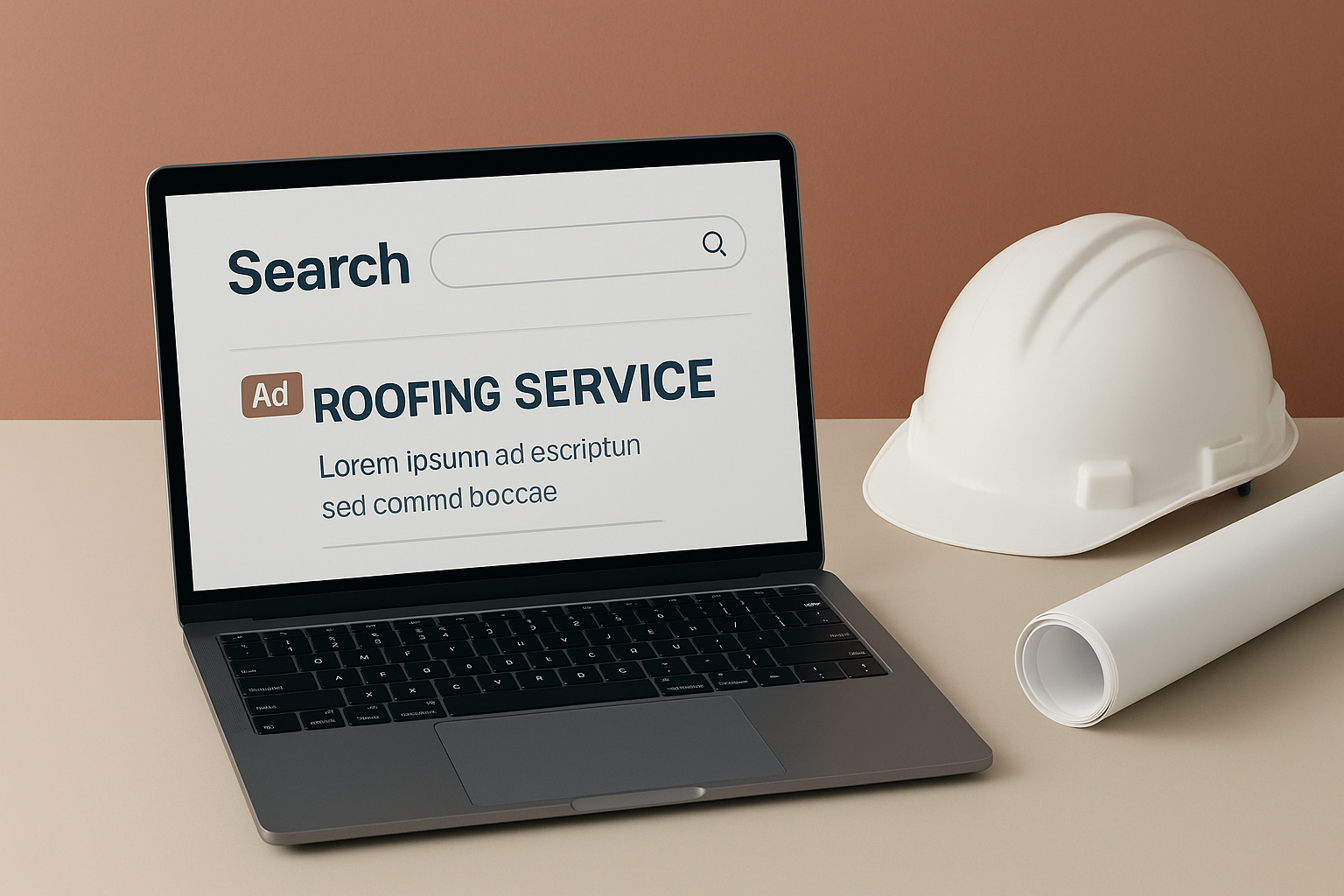 Finished roofing search ads, built directly from a competitor's lowest-rated reviews.
Real Examples: Roofing Search Ads Built From Reviews
Below is a side-by-side look at generic roofing ad copy versus copy built from a scored weakness theme. Both examples fit inside Google's character limits, and neither names a competitor directly.
Generic Copy (Weak) Weakness-Based Copy (Specific) "Licensed Roofing Experts" (24 chars) "On-Time or We Call First" (25 chars) "Free Estimates Available Today" (31 chars, over limit) "One Price, No Surprise Bill" (28 chars) "We treat every job with the care your roof deserves, from inspection to final cleanup." (89 chars) "We text when we're on the way, and we call within 48 hours if anything feels off." (84 chars) Notice the pattern: the weakness-based column answers a doubt a homeowner already has, instead of describing the company in the abstract. The same approach works across trades. The HVAC Google Ads examples article shows nearly identical structures applied to a different vertical, and the plumbing customer acquisition guide covers how this fits into a broader local lead-generation strategy beyond paid search alone.
Backfire Protection: The Check Most Roofers Skip
Before publishing any claim, run it against the roofer's own review history first. If the same weakness shows up there too, the ad should be rewritten or shelved, because a homeowner who clicks an ad promising fast callbacks and then finds a one-star review complaining about the opposite will not convert. Above all, this check matters more than clever copywriting, since no headline survives contact with contradicting proof in the next browser tab.
It is also worth noting the legal side of this strategy. The FTC's advertising guidance for small businesses is clear that claims must be truthful and substantiated. Building copy from a verified backfire check, rather than a guess, keeps campaigns compliant while still being specific. For roofing companies running campaigns through an agency, pairing this review-based approach with ready-made structure, like the templates in the HVAC campaign template guide, speeds up the handoff from research to a live ad group considerably.
 Every unhappy review is public data waiting to become the next roofing ad.
Frequently Asked Questions About Google Ads Copy for Roofers
What is Google Ads copy for roofers?
Google Ads copy for roofers is the headline and description text shown when a homeowner searches for roofing help on Google. The strongest version names a specific outcome, like an on-time arrival or an upfront price, instead of generic claims like licensed and insured.
Why do most roofing ads sound the same?
Most roofing companies write ad copy from a template of generic trust signals, such as licensed, insured, and free estimates, because that is what every competitor already says. As a result, none of it differentiates one roofer from the next in a crowded market.
What are the best headlines for roofing Google Ads?
The best headlines name a specific outcome a homeowner wants that a competitor's reviews suggest they are not getting, such as same-day quotes with no surprise fees or a crew that calls before it's late. Headlines built from real complaint language consistently outperform generic trust claims.
Can I mention a competitor by name in my roofing ads?
No, naming a specific competitor raises legal and policy risk and rarely performs better than a well-targeted implied comparison. Address the weakness without naming who has it, since the homeowner already has that competitor's reviews open in another tab.
How do I find out what my roofing competitors' customers complain about?
Read the one, two, and three-star reviews on each competitor's Google Business Profile directly, since the five-star highlight reel will not show the pattern. Services like WeakSpot automate this by reading a competitor's entire review history and clustering complaints into scored weakness themes with supporting quotes.
Should I use review complaints in my own roofing ads?
Yes, but only after confirming your own reviews do not show the same pattern, otherwise the ad invites a comparison you would lose. This check, sometimes called backfire protection, is the step most roofing companies skip before launching a new campaign.
Turning Competitor Weak Spots Into Your Next Roofing Lead
Ultimately, strong google ads copy for roofers comes down to one habit: reading what competitors' unhappy customers actually said, checking that the same complaint does not apply at home, and writing the headline that answers it in plain, specific language. Generic trust claims will keep blending into a market where everyone already looks like a 4.9-star contender. Specific, reviewed, and backfire-checked copy is what finally breaks a roofing company out of that tie. For owners who want this process done for them each month, rather than built from scratch, a free self-analysis at weakspot.io is the natural next step before writing another headline.
